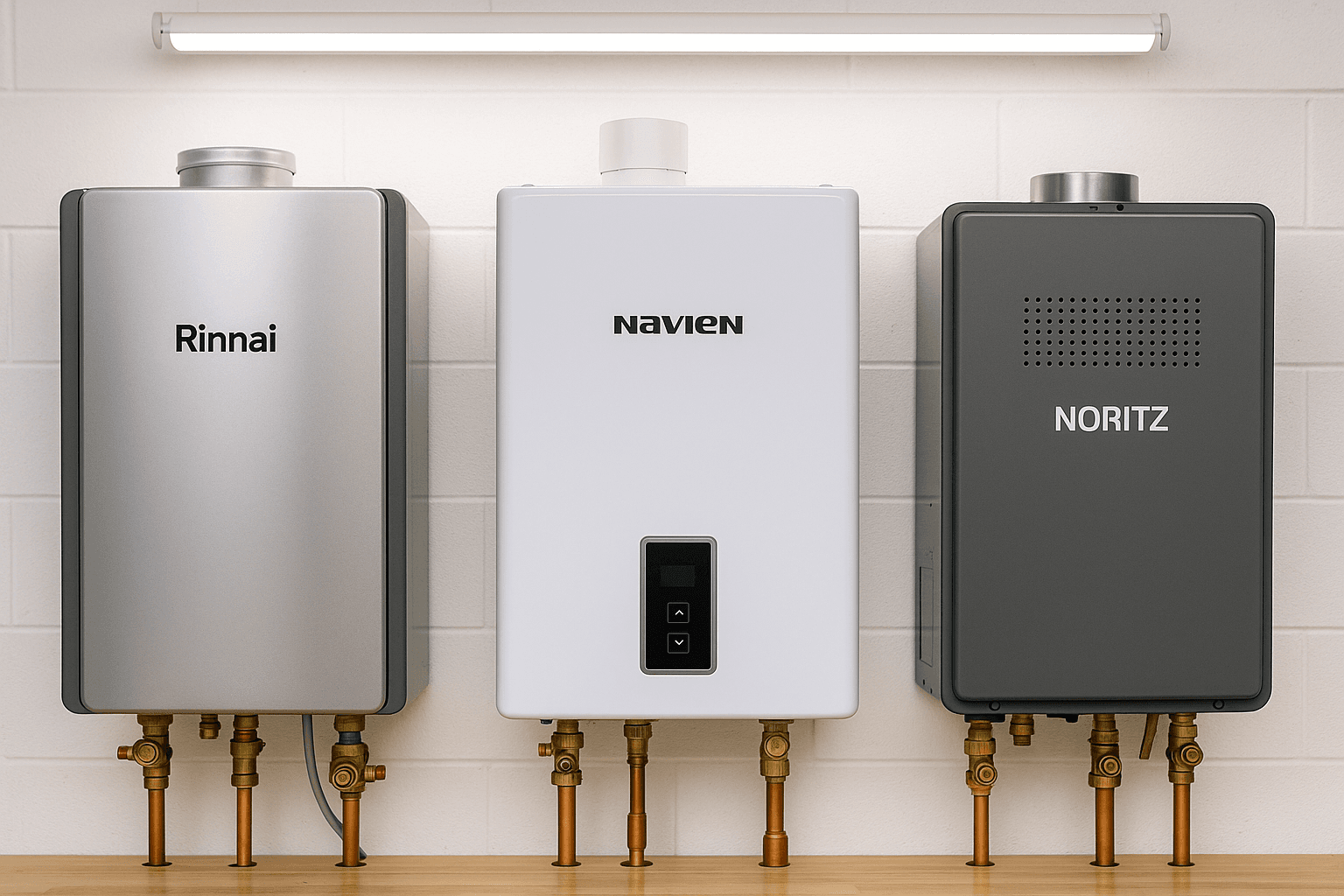
Rinnai vs. Navien vs. Noritz: Which Tankless Water Heater Needs the Most Maintenance in Orange County?
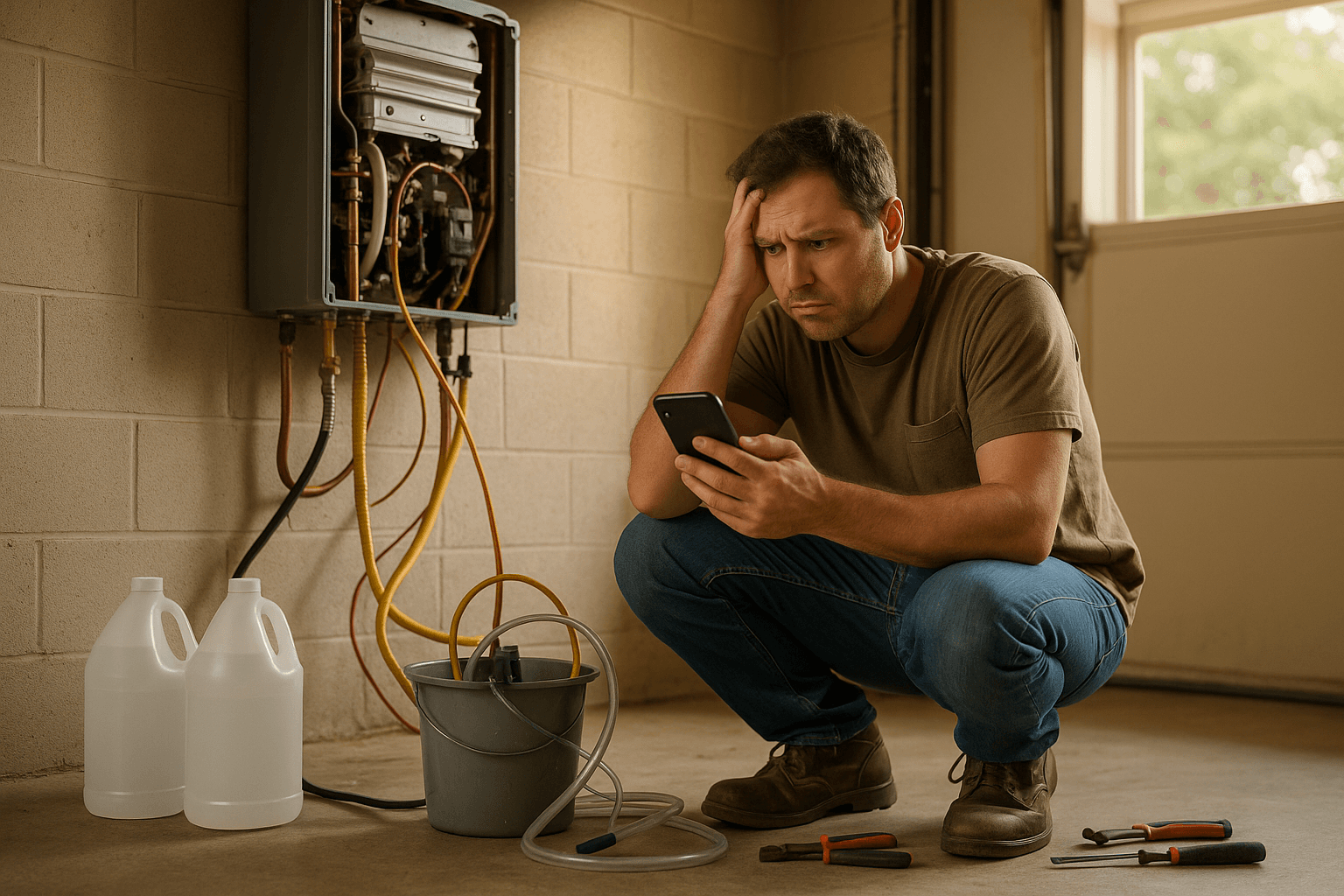
If you already own a Rinnai, Navien, or Noritz tankless water heater — or you're deciding between them — one of the most practical questions you can ask is: how much maintenance does each brand actually require in Orange County's hard water?
The answer isn't the same for all three. Each brand has design differences, diagnostic features, and vulnerabilities that change how often you need to flush, what to watch for, and how much maintenance costs over the life of the unit.
This comparison is based on our experience servicing all three brands across Orange County, where water hardness runs 250-400 ppm — well above the conditions most manufacturer guidelines are written for.
Why Brand Matters When It Comes to Maintenance in Hard Water Areas
All tankless water heaters use the same basic principle: a gas burner heats water as it flows through a heat exchanger. All of them accumulate scale in hard water. All of them need regular flushing.
But the similarities end at the engineering details. Each manufacturer uses different heat exchanger materials, different ignition systems, different diagnostic software, and different approaches to alerting homeowners about maintenance needs. In an area with moderate water hardness, these differences are minor. In Orange County's extreme hard water, they become significant.
The brand that holds up fine with annual maintenance in Sacramento may need attention every six months in Mission Viejo. The brand with the best diagnostic system gives you a warning before performance drops. The brand without one lets scale accumulate silently until an error code shuts the unit down.
Let's break down each brand.
Rinnai Maintenance: What the Manual Says vs. What OC Requires
Rinnai is the most widely installed tankless water heater brand in the United States, and for good reason. Their units are reliable, well-supported, and come with one feature that sets them apart in hard water areas: the LC code countdown system.
The LC Code: Rinnai's Built-In Maintenance Alert
Rinnai units track cumulative operating hours and display an LC code on the control panel when the unit calculates that descaling is due. This is not an error code — it's a preventive maintenance reminder. The unit continues to operate normally when LC appears, but it's telling you that scale accumulation has likely reached a level that warrants flushing.
This is a genuine advantage in Orange County. Most homeowners don't track when their last flush was. The LC code does that tracking for them, removing the guesswork from maintenance scheduling.
Rinnai's Official Recommendation vs. Orange County Reality
Rinnai's documentation recommends descaling at least once per year, with more frequent flushing in areas where water hardness exceeds 200 ppm. Since Orange County consistently exceeds 250 ppm — and South OC routinely hits 350-400 ppm — Rinnai's own guidelines acknowledge that annual flushing isn't enough here.
Our recommendation for Rinnai in Orange County: Every 6-9 months without a water softener. Every 12 months with a softener installed and functioning properly.
What We See in the Field
Rinnai heat exchangers hold up well in hard water when maintained on schedule. Their copper heat exchangers respond effectively to commercial descaling solutions, and we rarely encounter scale so hardened that it can't be removed in a single flush — provided the interval hasn't exceeded 18 months.
The most common issue we see with neglected Rinnai units is the Code 11 (ignition failure), which occurs when scale restricts water flow enough to cause the heat exchanger to overheat and trigger a safety shutdown. For a full list of scale-related codes across all brands, see our error code guide for Rinnai, Navien, and Noritz. This is almost always resolved by flushing.
Navien Maintenance: Why the Flame Rod Makes Navien More Scale-Sensitive
Navien has gained significant market share in recent years, largely due to their excellent energy efficiency ratings and competitive pricing. Their condensing technology extracts more heat per BTU of gas, which translates to lower operating costs.
However, Navien units have a specific vulnerability in hard water areas that other brands don't share to the same degree: the flame rod sensor.
The Flame Rod Problem
Every gas-fired tankless water heater uses a flame rod (also called a flame sensor) to verify that the burner has ignited successfully. If the flame rod doesn't detect a flame, the unit shuts down for safety.
On Navien units, the flame rod is positioned in a way that makes it particularly susceptible to scale accumulation. As mineral deposits coat the rod, its ability to sense the flame diminishes. Eventually, the rod can no longer detect the flame even though the burner is firing normally, and the unit throws an E003 error (ignition failure) and shuts down.
This is uniquely frustrating because the unit isn't actually failing to ignite — it's failing to detect that it ignited. The flame rod just can't "see" through the scale.
Navien's Maintenance Implications
The flame rod issue means Navien units in Orange County often need attention before the heat exchanger itself becomes critically scaled. You might have a heat exchanger with only moderate scale that would still perform adequately, but a flame rod so coated that the unit won't stay lit.
During a professional flush, the flame rod should be cleaned or inspected as part of the service. This is not a standard step with all service providers, but it should be.
Our recommendation for Navien in Orange County: Every 6 months without a water softener. Every 9-12 months with a softener. The flame rod issue pushes the interval shorter than Rinnai.
Navien's Diagnostic System
Navien does not have a countdown system equivalent to Rinnai's LC code. The unit displays error codes when something goes wrong, but it doesn't proactively alert you that maintenance is approaching. This means Navien owners need to be more disciplined about scheduling flushes on a calendar rather than waiting for the unit to tell them.
What We See in the Field
When maintained on schedule, Navien units are excellent performers. Their condensing technology means lower gas bills, and the build quality is solid. The challenge is that "on schedule" in Orange County means every 6 months for Navien — a frequency that many homeowners underestimate.
The most common service call we get for Navien is the E003 error, followed by E016 (overheating). Both are scale-related and both are resolved by flushing and flame rod cleaning.
Noritz Maintenance: No Warning Before Error Codes
Noritz builds reliable, well-engineered tankless water heaters. Their units are known for longevity and straightforward serviceability. But Noritz has a significant gap in hard water areas: no proactive maintenance alert system.
The Silent Accumulation Problem
Unlike Rinnai's LC code countdown, Noritz units give you no advance warning that scale is building up. The unit operates normally until it doesn't. When scale finally causes a problem — restricted flow, overheating, ignition failure — you get an error code and a cold shower.
Noritz's most common scale-related errors are Error 11 (no ignition) and Error 16 (overheating). By the time these codes appear, the heat exchanger typically has significant scale accumulation that has been building for months.
Noritz's Official Recommendation
Noritz recommends annual descaling as a minimum, with more frequent service in hard water areas. Like Rinnai and Navien, this recommendation was written for national conditions, not Orange County's extreme water hardness.
Our recommendation for Noritz in Orange County: Every 6-9 months without a water softener. Every 12 months with a softener.
The Proactive Approach
Because Noritz won't tell you when it needs flushing, you need to tell it. The most reliable strategy is setting a recurring calendar reminder based on the interval appropriate for your water hardness. Don't wait for symptoms. Don't wait for error codes. Schedule preventive flushes on a fixed calendar.
Indirect signs that scale is accumulating include gradually declining hot water pressure (compare hot to cold at the same fixture), water temperature that runs slightly below your set point, and any new noises during operation.
What We See in the Field
Noritz heat exchangers are robust and respond well to descaling when maintained. The units tend to be slightly more accessible for servicing, which is a minor advantage for the technician and can result in a slightly faster service visit.
The downside is that when Noritz owners skip maintenance — often because there's no reminder system — the scale accumulation tends to be more advanced by the time we see the unit. We encounter more "first-time flush after 2-3 years" situations with Noritz than with Rinnai, simply because Rinnai's LC code prompts owners to act sooner.
Side-by-Side Comparison Table
| Feature | Rinnai | Navien | Noritz |
|---|---|---|---|
| Recommended Flush Interval (OC, no softener) | Every 6-9 months | Every 6 months | Every 6-9 months |
| Recommended Flush Interval (OC, with softener) | Every 12 months | Every 9-12 months | Every 12 months |
| Built-In Maintenance Alert | Yes (LC code countdown) | No | No |
| Most Common Scale Error Code | Code 11 (ignition), Code LC (scale alert) | E003 (ignition), E016 (overheat) | Error 11 (ignition), Error 16 (overheat) |
| Scale-Sensitive Component | Heat exchanger | Heat exchanger + flame rod | Heat exchanger |
| Inlet Filter Cleaning | Every 6-12 months | Every 6-12 months | Every 6-12 months |
| Average Flush Cost (OC market) | $200-$350 | $200-$350 | $200-$350 |
| Tankless Flush Pro Flat Rate | $399 | $399 | $399 |
| Warranty Requires Documented Maintenance | Yes | Yes | Yes |
| Heat Exchanger Material | Copper | Stainless steel | Copper or stainless (model dependent) |
| Typical Lifespan (well-maintained) | 15-20 years | 15-20 years | 15-20 years |
| Typical Lifespan (neglected in OC hard water) | 8-12 years | 7-10 years | 8-12 years |
Which Brand Holds Up Best in Orange County Hard Water?
After servicing hundreds of Rinnai, Navien, and Noritz units across Orange County, here's our honest assessment based on field experience — not manufacturer marketing.
Rinnai: Best for Reliability and Low-Maintenance Ownership
Rinnai gets the edge for Orange County homeowners who want the most straightforward ownership experience. The LC code countdown removes the guesswork from maintenance scheduling. The copper heat exchangers respond well to descaling. And the units tend to degrade gracefully — meaning you get warning signs and reduced performance before you get a complete shutdown.
If you want to set it and forget it (within reason), Rinnai is the safest choice in hard water.
Navien: Best for Efficiency When Properly Maintained
Navien's condensing technology delivers the best energy efficiency of the three brands, which translates to measurably lower gas bills. If you're disciplined about maintaining a 6-month flush schedule and your service provider cleans the flame rod during each visit, a Navien will reward you with the lowest operating costs.
The trade-off is that Navien requires the most attentive maintenance schedule. Miss a flush in hard water, and the flame rod issue can take the unit offline before the heat exchanger is even critically scaled.
Noritz: Solid and Durable, but Requires Proactive Care
Noritz builds dependable units that perform well for years when maintained. The hardware is solid, the heat exchangers are well-constructed, and the units are reasonably straightforward to service.
The weakness is the lack of any proactive diagnostic system. Noritz owners need to be their own maintenance department — setting reminders, watching for subtle signs, and flushing on schedule without prompting from the unit.
How to Set a Maintenance Reminder That Matches Your Brand
Based on the brand-specific requirements outlined above, here's a practical approach to staying on schedule:
For Rinnai Owners
Your unit's LC code does most of the work. When you see LC on the display, schedule a flush within the next 2-4 weeks. As a backup, set a calendar reminder for every 8 months — this ensures you don't miss a window even if you overlook the LC alert.
For Navien Owners
Set a recurring reminder every 6 months from the date of your last flush. Do not rely on error codes as your prompt — by the time you see E003 or E016, you've already experienced a shutdown. Mark two dates per year on your calendar, and treat them like a non-negotiable appointment.
When scheduling your flush, specifically request flame rod cleaning as part of the service. Not all providers include this step automatically.
For Noritz Owners
Set a recurring reminder every 7-8 months. Without a built-in alert system, this calendar reminder is your only early warning. Between scheduled flushes, periodically compare your hot water pressure to your cold water pressure at the same fixture. Any noticeable decline in hot water flow is a signal that scale is accumulating.
For All Brands
Consider aligning your flush schedule with something you already remember — a seasonal marker works well. For example, flush in early spring and early fall. This gives you roughly 6-month intervals and ties the task to something already in your awareness.
Maintenance Protects Your Warranty, Too
All three brands — Rinnai, Navien, and Noritz — require documented regular maintenance as a condition of their warranty terms. If your heat exchanger fails at year 6 of a 10-year warranty and you can't produce records showing regular flushing, the manufacturer can deny the warranty claim.
This applies equally to all three brands. A professional flush service that provides warranty-compliant documentation after each visit protects both your equipment and your warranty coverage.
The Brand Doesn't Matter If You Don't Flush
Here's the truth that cuts across all three brands: a well-maintained Navien will outperform a neglected Rinnai every single time. A flushed Noritz will outlast an unflushed Rinnai by years. Brand selection matters, but maintenance discipline matters more.
In Orange County's hard water, no brand is maintenance-free. No brand can go years without flushing and perform as designed. The differences between brands are measured in months of flush interval and the presence or absence of a warning system. The difference between maintained and neglected is measured in thousands of dollars of premature replacement costs.
Tankless Flush Pro services all three brands at a flat rate of $399 — no trip fees, no brand surcharges, anywhere in Orange County. Every service includes commercial-grade descaling, inlet filter cleaning, full system inspection, and warranty-compliant documentation.
Schedule your flush today and keep your Rinnai, Navien, or Noritz performing at the level you paid for.