Hard Water in Orange County: What It's Doing to Your Tankless Water Heater Right Now
You can't see it, smell it, or taste it in any obvious way. But the water flowing through your pipes in Orange County is quietly destroying the most expensive component inside your tankless water heater.
Orange County has some of the hardest water in California. That hard water carries dissolved minerals—primarily calcium and magnesium—that deposit onto every surface the hot water touches. Inside your tankless unit, those minerals are cooking onto the heat exchanger at temperatures exceeding 120 degrees, forming a rock-hard layer of scale that gets thicker every single day.
Here's what's actually happening inside your unit, why Orange County is uniquely problematic, and what you can do about it.
How Hard Is Orange County's Water, Really?
Water hardness is measured in parts per million (ppm) of dissolved calcium carbonate. The EPA uses this scale:
| Classification | PPM Range |
|---|---|
| Soft | 0-60 |
| Moderately Hard | 61-120 |
| Hard | 121-180 |
| Very Hard | 180+ |
Orange County's water consistently tests between 250 and 400 ppm. That's not just "very hard." It's among the hardest municipal water in the entire state of California.
For comparison, Los Angeles averages around 200-250 ppm. San Francisco sits at 20-50 ppm. San Diego ranges from 200-400 ppm, similar to OC. The national average is approximately 100 ppm.
Orange County homeowners are dealing with water that is 2.5 to 4 times harder than the national average.
Which Orange County Cities Have the Hardest Water?
Water hardness varies across the county based on the water district, the mix of groundwater versus imported water, and local geology. Here's how different parts of Orange County generally stack up:
South Orange County (Highest Hardness: 300-400+ ppm)
- Laguna Niguel — Consistently among the hardest in the county, frequently exceeding 380 ppm
- Lake Forest — Groundwater-heavy supply pushes hardness above 350 ppm
- San Juan Capistrano — Historic groundwater sources produce very high mineral content
- Mission Viejo — Typically 320-380 ppm depending on the specific neighborhood and water source
- San Clemente — Similar range to Mission Viejo, with seasonal variation
- Rancho Santa Margarita — Regularly above 340 ppm
- Ladera Ranch — Draws from the same South OC sources, consistently hard
Central Orange County (Moderate-High Hardness: 275-350 ppm)
- Irvine — Ranges widely from 250-350 ppm depending on the village and water district
- Tustin — Typically 280-330 ppm
- Orange — Similar to Tustin, mid-300s common
- Santa Ana — 270-330 ppm
- Costa Mesa — 260-320 ppm
- Newport Beach — 270-340 ppm
North Orange County (Lower-High Hardness: 250-320 ppm)
- Anaheim — 250-310 ppm, slightly lower due to water source mix
- Fullerton — 260-310 ppm
- Brea — 250-300 ppm
- Yorba Linda — 270-320 ppm
- Placentia — 260-310 ppm
Even in the "softest" areas of Orange County, the water is still classified as very hard by EPA standards.
How Hard Water Creates Scale Inside Your Heat Exchanger
Understanding the science helps explain why this problem is so persistent and why it requires ongoing maintenance—not a one-time fix.
The Chemistry
When cold water enters your tankless unit, it passes through a heat exchanger—a series of narrow copper or stainless steel tubes surrounded by burner flames. As water temperature rises above approximately 140 degrees Fahrenheit, dissolved calcium carbonate becomes less soluble. It precipitates out of the water and adheres to the hot metal surfaces.
This process is called precipitation hardening, and it happens every single time your unit fires. Every shower, every dishwasher cycle, every time you wash your hands with hot water, a thin layer of calcium deposits onto the heat exchanger walls.
The Accumulation
In Orange County's water, the rate of scale accumulation is roughly:
- Month 1-3: A thin, chalky film begins to form. No noticeable performance impact.
- Month 3-6: Scale becomes visible as a white or off-white coating. Minor efficiency loss begins (5-10%).
- Month 6-12: Scale reaches 1-2mm thickness in high-heat areas. Efficiency loss is measurable (10-20%). Flow restriction begins. You may start noticing warning signs that your unit needs flushing.
- Month 12-18: Scale exceeds 2mm in spots. Significant flow restriction, temperature inconsistency, and possible error codes. Efficiency loss approaches 25%.
- Month 18+: Risk of permanent damage increases sharply. Scale may become too hardened for chemical descaling alone.
What Scaled Heat Exchangers Look Like
We flush tankless water heaters across Orange County every day, and the difference between a maintained and neglected heat exchanger is striking.
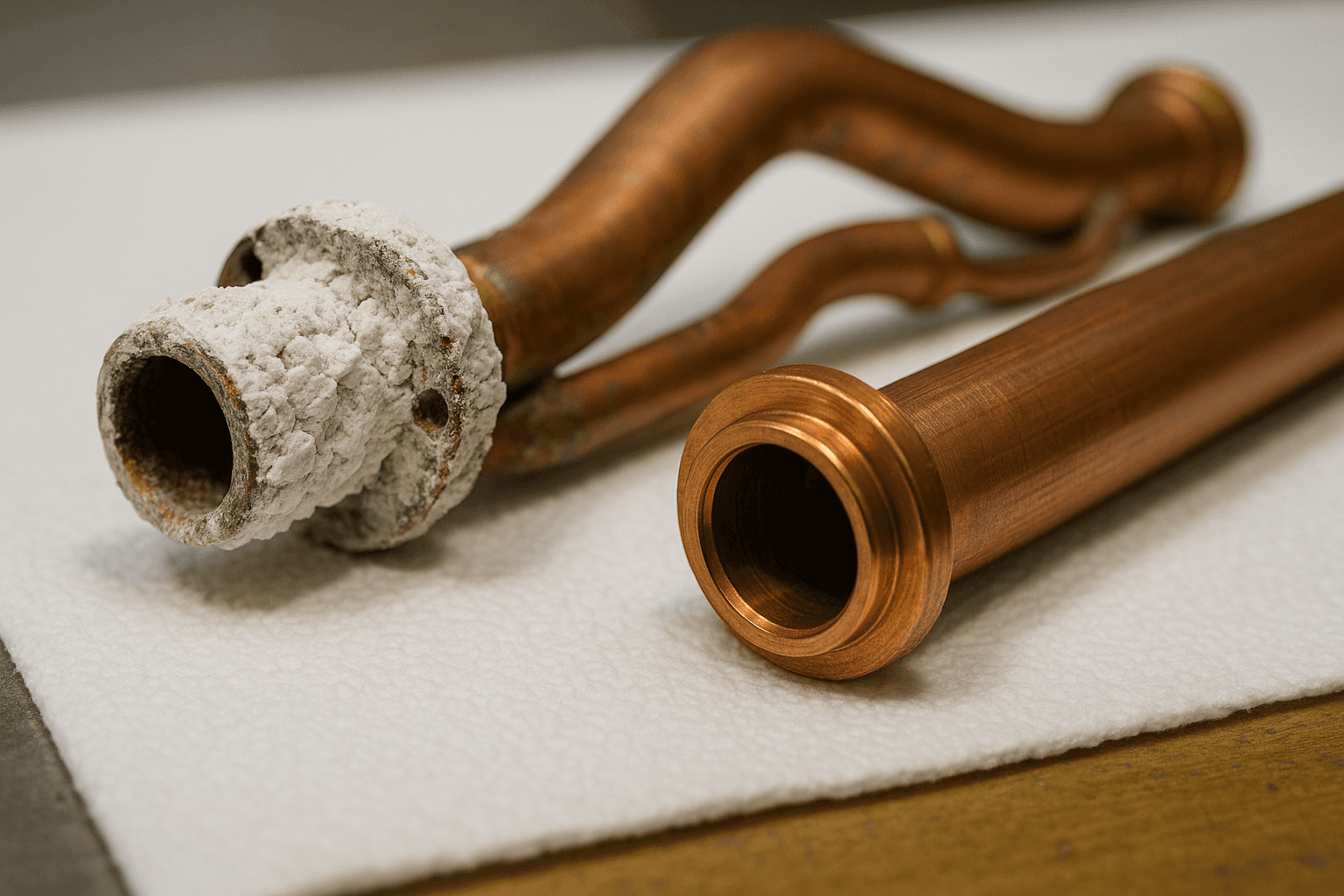
A clean heat exchanger has smooth, shiny copper or stainless steel surfaces. Water flows freely through wide-open passages. The metal is uniform in color and texture.
A scaled heat exchanger looks like the inside of a cave. White and grey mineral deposits coat every surface, sometimes thick enough to narrow the water passages by 30-50%. The scale is layered—smooth in some spots, rough and crystalline in others. In severe cases, chunks of scale break off and lodge in the narrowest points of the exchanger, creating complete blockages in individual tubes.
The worst cases we've seen in Orange County—units that went 3-4 years without flushing—had scale deposits thick enough that the descaling solution barely penetrated. Some required multiple flush cycles over two visits to restore reasonable flow.
Why Tankless Units Are More Susceptible Than Tank Water Heaters
If you've had a traditional tank water heater before, you might think scale is manageable. After all, tank heaters can go years without flushing in hard water areas. Why are tankless units different?
Concentrated Heat
A tank water heater heats a large volume of water relatively slowly using a burner at the bottom of the tank. The heat is distributed across a large surface area. A tankless unit forces water through a compact heat exchanger at extremely high temperatures. The heat is concentrated on a small surface area, which accelerates the precipitation of calcium carbonate.
Higher Surface Temperature
The heat exchanger walls in a tankless unit reach much higher temperatures than the walls of a storage tank. Higher temperatures mean faster and harder scale formation.
Narrow Passages
The water passages in a tankless heat exchanger are narrow by design—they need to be for efficient heat transfer. This means even a small amount of scale has a proportionally large impact on flow. A 1mm layer of scale in a passage that's only 8mm wide reduces the cross-sectional area by nearly 50%.
On-Demand Cycling
A tank water heater fires once to heat a full tank, then waits. A tankless unit fires every time hot water is requested, which can be dozens of times per day in an active household. Each firing cycle deposits more scale.
The Real Cost of Hard Water Damage
Efficiency Loss
Research from the Water Quality Association found that scale buildup of just 1/16 of an inch (about 1.5mm) on a heat exchanger can reduce efficiency by up to 12%. At the scale thickness commonly found in neglected Orange County units, efficiency losses of 20-25% are typical.
On a household gas bill of $100/month where water heating accounts for 35% of usage, a 25% efficiency loss means roughly $8-$9 per month in wasted gas. That's $100+ per year you're paying to heat calcium instead of water.
Lifespan Reduction
A well-maintained tankless water heater should last 15-20 years. The heat exchanger is the most critical component, and it's designed to handle decades of use—as long as scale is removed regularly.
Without regular flushing in Orange County's hard water, that lifespan drops to 8-10 years. The heat exchanger fails prematurely from overheating (caused by insulating scale), corrosion beneath scale deposits, or mechanical failure from thermal stress.
Replacing a tankless water heater costs $2,000-$4,500 depending on the brand and installation complexity. The difference between a 10-year lifespan and a 20-year lifespan represents $2,000-$4,500 in avoided replacement costs.
Repair Costs
Before complete failure, a scaled heat exchanger often needs repair. Common repair costs for scale-related damage:
- Heat exchanger replacement: $800-$1,500
- Flow sensor replacement: $200-$400
- Thermal fuse replacement: $150-$300
- Gas valve replacement: $300-$600
These repairs are almost entirely preventable with regular flushing. See our flush cost guide for Orange County for what preventive maintenance actually costs.
Should You Get a Water Softener Too?
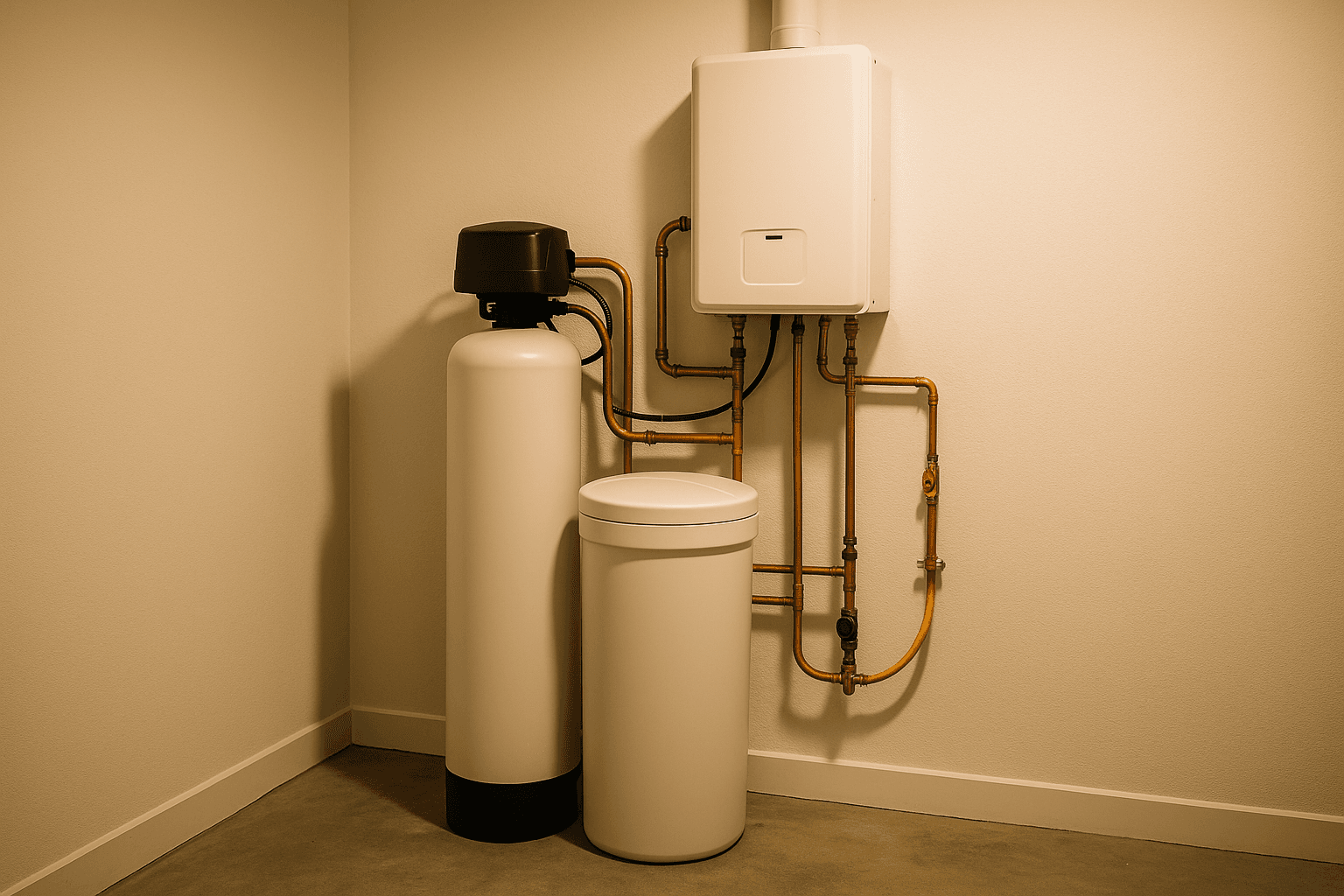
Water softeners remove calcium and magnesium from your water supply by exchanging them for sodium ions. For Orange County homeowners with tankless water heaters, a water softener is a legitimate consideration.
Pros of Adding a Water Softener
- Dramatically reduces scale formation in the heat exchanger and throughout your entire plumbing system
- Extends the interval between necessary flushes from 6-9 months to 12+ months
- Protects other appliances (dishwasher, washing machine, faucets, showerheads)
- Reduces soap and detergent usage
- Eliminates hard water spots on glass and fixtures
Cons of Adding a Water Softener
- Upfront cost of $1,500-$3,500 for a quality whole-home system, installed
- Ongoing salt costs of $5-$15/month
- Uses 25-50 gallons of water per regeneration cycle
- Adds sodium to your water (can be addressed with a reverse osmosis drinking water system)
- Does not eliminate the need for flushing entirely—softeners can malfunction or bypass during regeneration
Our Recommendation
If you're building a new home or replacing your plumbing system, a water softener is an excellent investment for Orange County. If you already have a tankless unit and want to protect it as cost-effectively as possible, regular professional flushing at the right interval is the most practical solution.
A water softener plus annual flushing is the gold standard. Regular flushing without a softener (every 6-9 months) is the minimum responsible approach. If you're considering handling flushes yourself, read our DIY vs. professional flush comparison to understand the trade-offs.
How Often to Flush with Orange County's Hard Water
Most manufacturer guidelines recommend annual flushing. Those guidelines are written for areas with average water hardness.
For Orange County, we recommend the following schedule:
| Water Hardness | Softener Installed? | Recommended Flush Interval |
|---|---|---|
| 250-300 ppm | Yes | Every 12 months |
| 250-300 ppm | No | Every 9-12 months |
| 300-350 ppm | Yes | Every 9-12 months |
| 300-350 ppm | No | Every 6-9 months |
| 350-400+ ppm | Yes | Every 9 months |
| 350-400+ ppm | No | Every 6 months |
If you're not sure about your specific water hardness, your water district publishes annual water quality reports, and the USGS provides water quality data for monitoring sites across California. You can also pick up a water hardness test strip kit at any hardware store for under $10.
Protect Your Tankless Water Heater from Orange County's Hard Water
You can't change the water that comes into your home, but you can prevent it from destroying your tankless water heater. Regular professional flushing is the single most effective thing you can do.
Tankless Flush Pro provides flat-rate $399 tankless water heater flushing throughout Orange County. Every service includes commercial-grade descaling, inlet filter cleaning, full system inspection, and warranty-compliant documentation. No trip fees, regardless of where you are in the county.
Schedule your flush today and stop hard water from shortening the life of your tankless water heater.