5 Warning Signs Your Tankless Water Heater Needs to Be Flushed Right Now
Your tankless water heater doesn't come with a dashboard light that says "flush me." It gives you subtler signals—ones that are easy to ignore until they turn into expensive problems.
If you live in Orange County, where water hardness routinely hits 250-400 parts per million, these warning signs show up faster and more aggressively than in areas with softer water. Here are the five symptoms you should never ignore, and what to do about each one.
Sign 1: Inconsistent Water Temperature
This is the most common complaint we hear from Orange County homeowners, and it has a specific name in the industry: cold water sandwiching.
Here's what it feels like. You turn on the shower and get hot water. Then it suddenly goes cold for 10-15 seconds. Then hot again. The cycle might repeat, or the water might stabilize at a temperature that's lower than what you set.
Why This Happens
Scale buildup on the heat exchanger creates an insulating layer between the burner and the water flowing through the unit. As scale accumulates unevenly across the exchanger, some sections transfer heat efficiently while others don't. The result is water that exits at inconsistent temperatures.
In the early stages, you might only notice this during low-flow situations—washing hands, for example, where the flow rate is barely above the unit's minimum activation threshold. As scale gets worse, temperature swings happen even at full flow.
What to Do
If temperature fluctuations are new or getting worse, schedule a flush. In most cases, a thorough descaling resolves the issue completely within one service visit.
Sign 2: Reduced Hot Water Flow and Pressure
Walk around your house and compare the flow rate from your hot water taps to your cold water taps. If there's a noticeable difference—hot water comes out slower or with less pressure—your tankless unit is likely restricted by scale.
Why This Happens
Mineral scale narrows the internal passages in the heat exchanger. Think of it like cholesterol in an artery. Water can still flow through, but the diameter of the passage shrinks with every month of hard water exposure. Less water gets through per second, which means lower flow and lower pressure at your taps.
The inlet filter can also contribute. This small mesh screen catches sediment before it enters the heat exchanger, and it can become clogged over time—especially in older homes with galvanized pipes.
What to Do
A professional flush addresses both issues. The descaling solution dissolves calcium and mineral deposits from the heat exchanger, and the technician will clean or replace the inlet filter as part of the service.
Sign 3: Strange Noises from the Unit
A healthy tankless water heater is relatively quiet. You might hear the burner ignite with a soft click and the sound of the fan running. That's normal.
What's not normal:
- Rumbling or gurgling during operation
- Popping or cracking sounds, especially when the burner fires
- Loud clicking beyond the normal ignition sequence
- Whistling or high-pitched whining
Why This Happens
Scale deposits create hot spots on the heat exchanger. When water hits these superheated areas, it can flash to steam briefly, producing popping and rumbling sounds—similar to what you'd hear in an old tank water heater with sediment buildup at the bottom.
Whistling usually indicates restricted flow through a narrowed passage, where water is being forced through a smaller opening at higher velocity.
What to Do
Strange noises from a tankless unit almost always mean scale. Don't wait to see if it gets worse. The same scale causing noise is also causing efficiency loss, temperature problems, and accelerated wear on the heat exchanger. Flush it now, and the noises should stop.
Sign 4: Error Codes on the Display Panel
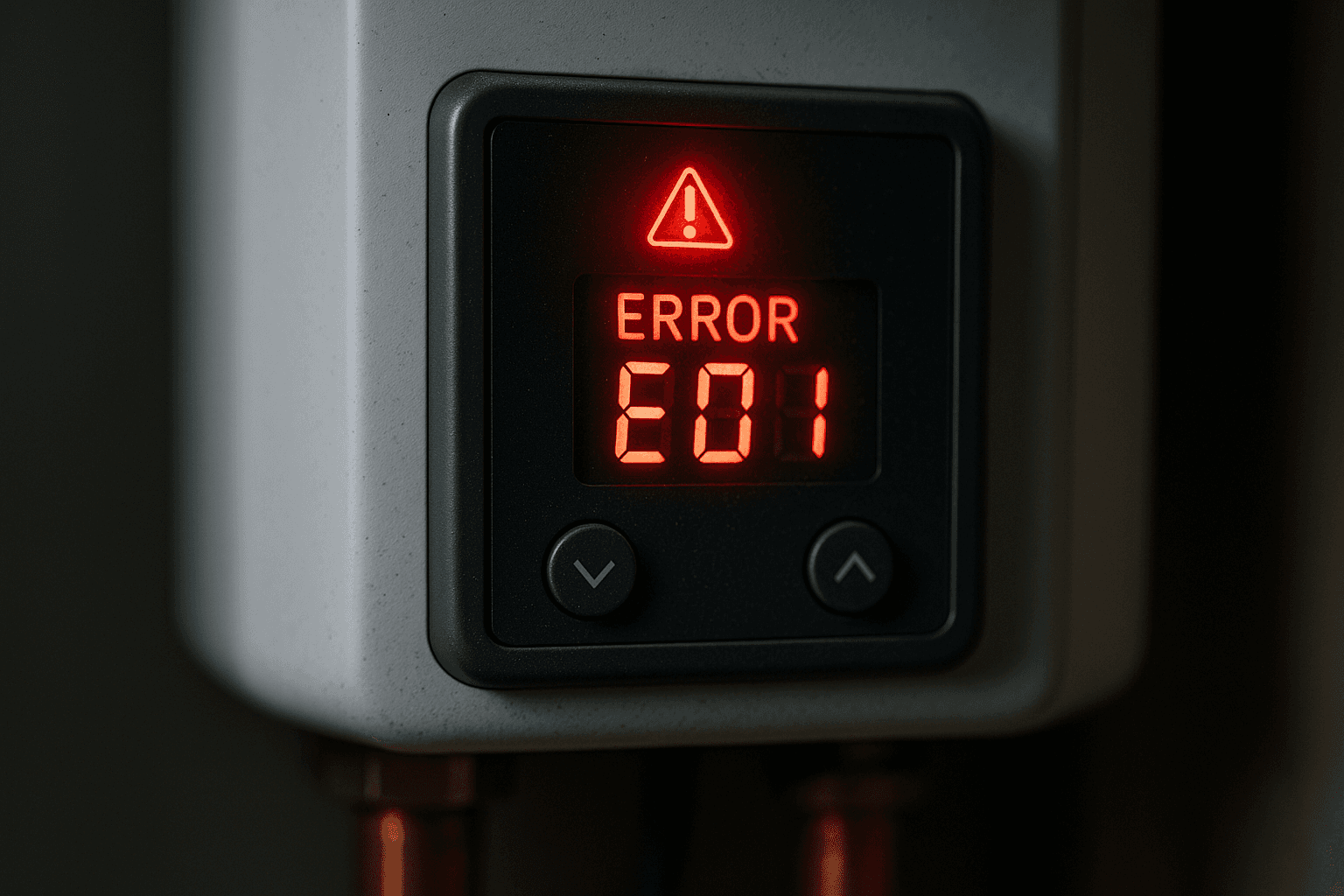
Modern tankless water heaters have built-in diagnostics that display error codes when something's wrong. Many of the most common error codes are directly related to scale buildup, even when the code itself doesn't explicitly say "descale."
Common Scale-Related Error Codes by Brand
Rinnai:
- Code 11 — Ignition failure. Often caused by the heat exchanger overheating due to restricted water flow from scale, triggering a safety shutdown.
- Code LC — Rinnai's built-in scale detection alert. This is a direct "flush me" signal. Some models display this based on a timer, others based on flow sensor readings.
- Code 14 — Thermal fuse failure. Can be triggered by overheating from scale.
Navien:
- E003 — Ignition failure. Frequently caused by scale-related overheating.
- E016 — Overheating. The unit detects that the heat exchanger temperature is too high, which is a classic symptom of scale restricting water flow.
- E030 — Exhaust overheat. Can result from the unit working harder to heat water through a scaled exchanger.
Noritz:
- Error 11 — No ignition. Same mechanism as Rinnai code 11.
- Error 16 — Overheating at the heat exchanger.
Rheem:
- Code 13 — Combustion abnormality, often from overheating.
- Code 11 — No ignition.
What to Do
If you see any of these codes, try resetting the unit first (power off for 30 seconds, then back on). If the code returns, schedule a professional flush. In our experience, a thorough descaling resolves these error codes about 70% of the time. If the code persists after flushing, further diagnostics are needed.
Sign 5: Higher Than Normal Gas or Electric Bills
This one creeps up slowly enough that most homeowners don't connect the dots. If your gas bill (or electric bill for electric tankless units) has been gradually climbing over the past 6-12 months without a change in usage patterns, your tankless water heater's efficiency may be declining due to scale.
Why This Happens
A clean heat exchanger transfers energy from the burner to the water efficiently. Scale is an insulator. As it builds up, more gas has to be burned to achieve the same water temperature. According to the U.S. Department of Energy, maintaining your water heater is critical for efficiency, and studies have shown that significant scale buildup can reduce heat transfer efficiency by up to 25%.
On a typical Orange County household that spends $80-$120/month on gas, a 25% efficiency loss on water heating (which accounts for roughly 30-40% of your gas bill) translates to an extra $6-$12 per month in wasted energy. Over a year, that's $72-$144 you're literally burning for nothing.
What to Do
After your next flush, compare your gas bills from the following two months to the same period the previous year. Many homeowners are surprised to see a measurable drop. It's one of the clearest indicators that flushing is making a real difference.
Bonus: It's Been More Than 12 Months Since Your Last Flush
Even if you're not experiencing any of the five signs above, if it's been more than a year since your last tankless water heater flush—or if you've never had one done—you're overdue.
Most manufacturers recommend annual flushing as a minimum. In Orange County, where water hardness is well above the national average, every 6-9 months is the more responsible schedule. Check our FAQ for more details on recommended flush intervals.
Think of it like an oil change for your car. You don't wait for the engine to start knocking. You change the oil on schedule to prevent the knocking from ever happening.
What Happens If You Ignore These Signs
Ignoring these warning signs doesn't just mean dealing with lukewarm showers. Here's the actual progression of damage:
- Months 1-6 after symptoms appear: Gradual efficiency loss, higher utility bills, occasional temperature fluctuations. Easy to dismiss.
- Months 6-12: More frequent error codes, noticeable flow reduction, consistent temperature problems. The scale is now thick enough to significantly restrict flow.
- Months 12-18: The unit begins to short-cycle (shutting down and restarting frequently). The heat exchanger is under stress. Components start wearing prematurely.
- Months 18-24+: Potential heat exchanger failure. This is an $800-$1,500 repair, or more if the unit is out of warranty. In some cases, the damage is severe enough that full unit replacement ($2,000-$4,500) is more cost-effective than repair.
A $399 flush prevents this entire cascade.
Orange County's Hard Water Makes Everything Worse
If you moved to Orange County from an area with softer water, you might be used to flushing every 18-24 months or even less frequently. That schedule does not work here.
Orange County's water supply comes from a mix of groundwater and imported water, both of which carry high concentrations of dissolved calcium and magnesium. Water hardness readings of 250-400 ppm are standard across most of the county, with some South OC areas exceeding 400 ppm.
For context, the EPA classifies water above 180 ppm as "very hard." Orange County is well above that threshold across the board.
This means every warning sign listed above will show up sooner and escalate faster than what you might read in generic maintenance guides written for areas with average water quality.
Take Action Before Symptoms Become Damage
If you're seeing any of these five warning signs, the good news is that catching them early means a standard flush will almost always resolve the issue. The heat exchanger can handle years of hard water exposure as long as scale is removed regularly.
Tankless Flush Pro offers flat-rate $399 flushing throughout Orange County, including commercial-grade descaling, inlet filter cleaning, full system inspection, and warranty-compliant documentation. No trip fees. No hidden charges.
Schedule your flush today and stop these warning signs before they become repair bills.