Low Hot Water Pressure? Your Tankless Water Heater Probably Needs a Flush
You turn on the kitchen faucet. Cold water comes out strong. You switch to hot and the flow drops to half of what it was. Same thing in the shower — cold side has solid pressure, hot side feels like it's struggling.
If this sounds familiar, your first instinct might be to call a plumber and worry about pipe replacements or a failing water heater. But if you have a tankless water heater in Orange County and the pressure problem is isolated to the hot side, the answer is almost always simpler than you think.
Why Pressure Drops on the Hot Side Only
This is the detail that confuses most homeowners and also the one that makes diagnosing the problem straightforward. When cold water pressure stays strong throughout the house but hot water pressure is noticeably weaker, the restriction has to be somewhere in the hot water path — specifically, inside or immediately around the tankless unit itself.
Cold water enters your home from the main supply line and splits into two paths. One goes directly to cold water fixtures. The other routes through your tankless water heater before continuing to hot water fixtures. Both paths share the same supply pressure from the street. If cold water pressure is fine, your home's plumbing infrastructure, your pressure regulator, and your supply line are all working correctly.
The bottleneck is inside the tankless unit. And in Orange County, the cause is almost always one of two things: scale buildup in the heat exchanger, or a clogged inlet filter. Often, it's both.
The Inlet Filter: The First Thing to Check
Every tankless water heater — Rinnai, Navien, Noritz, Rheem — has a small mesh filter on the cold water inlet. This filter is designed to catch sediment, debris, and mineral particles before they enter the heat exchanger. It's a good design feature, but it creates a maintenance item that most homeowners don't know about.
Over time, the inlet filter accumulates trapped particulates. In Orange County, where dissolved mineral content runs between 250 and 400 parts per million, the filter collects material significantly faster than in areas with softer water. Homes with older galvanized steel pipes accelerate the problem further, as corroding pipes shed rust particles into the water flow.
What a Clogged Inlet Filter Does
A partially clogged inlet filter restricts the volume of water entering the heat exchanger per second. The unit still fires and heats water normally, but less water flows through. At the tap, you experience this as reduced pressure on the hot side. In severe cases, the restriction can reduce flow below the unit's minimum activation threshold, causing the burner to cut out entirely and producing bursts of cold water that homeowners often misdiagnose as a failing unit.
Can You Clean It Yourself?
Technically, yes — close the isolation valves, remove the cold water inlet fitting, and pull out the small cylindrical screen. Rinse it and reinstall. But if the inlet filter is clogged, the heat exchanger behind it almost certainly has scale buildup too. Cleaning the filter without flushing the exchanger addresses one restriction while ignoring the larger one. The better approach is to have both handled during a single professional flush service.
Scale Buildup: The Bigger Problem Behind the Filter
The inlet filter catches particulates, but dissolved minerals pass right through it. Calcium and magnesium ions are dissolved in the water at a molecular level — no mesh filter can stop them. These minerals travel through the filter, enter the heat exchanger, and deposit onto the internal surfaces as the water is heated.
This is where the real flow restriction happens.
How Scale Narrows the Passages
Your tankless water heater's heat exchanger is a series of narrow tubes — typically copper or stainless steel — that carry water directly over the gas burner. When these tubes are clean, water flows through them freely at the full diameter. As scale deposits on the interior walls, the effective diameter of each tube shrinks.
Think of it like plaque building up inside an artery. The passage is still open, but the available space for flow decreases with every layer of mineral deposit. Water has to squeeze through a narrower channel, which means less volume per second and lower pressure at your fixtures.
The relationship between scale thickness and flow restriction isn't linear — it's exponential. Flow through a tube is proportional to the fourth power of the radius. Even small reductions in the tube's internal diameter have outsized effects on flow rate. A thin layer might reduce flow by 5-10%, but doubling the scale thickness roughly quadruples the restriction.
Orange County's Hard Water Accelerates Everything
In an area with moderate water hardness — say 100-150 ppm — meaningful scale accumulation on the heat exchanger might take 18-24 months. Orange County's water, testing at 250-400 ppm, delivers roughly 2-3 times the mineral load per gallon. That means the same level of scale buildup that takes two years elsewhere happens in 8-12 months here.
South Orange County cities are particularly aggressive. Laguna Niguel, Mission Viejo, Lake Forest, and San Juan Capistrano routinely test above 350 ppm. Homeowners in these areas who go more than a year without flushing are almost guaranteed to experience noticeable hot water pressure loss.
If you moved to Orange County from somewhere with softer water, your previous maintenance schedule doesn't apply here. Adjust accordingly.
What a Professional Flush Restores
A professional flush using commercial-grade descaling solution addresses both the inlet filter and the heat exchanger in a single service visit. Here's what changes after a thorough flush:
Flow rate recovery. The descaling solution dissolves calcium and mineral deposits from the interior of the heat exchanger tubes, restoring them to near-original diameter. In our experience, homeowners with moderate scale buildup see a 20-35% improvement in hot water flow rate after a flush. Severely scaled units can see even more dramatic improvement.
Pressure equalization. After a flush, the pressure difference between hot and cold water at your fixtures should be minimal. If you've been comparing them and noticing a gap, that gap closes significantly after descaling.
Inlet filter restoration. The technician removes, inspects, and cleans the inlet filter as part of the service. If the filter is damaged or too corroded to clean effectively, it gets replaced.
Temperature consistency. Restricted flow doesn't just affect pressure — it also affects temperature stability. When less water flows through the heat exchanger, the unit struggles to maintain consistent output temperature. Restoring full flow also restores consistent temperatures, which is why many homeowners notice that temperature fluctuations and insufficient hot water resolve simultaneously with the pressure issue.
How to Tell If Low Pressure Is Scale or a Bigger Plumbing Issue
Not every low hot water pressure problem is scale. Before scheduling a flush, run through this diagnostic checklist:
Signs It's Scale (Flush Will Fix It)
- Hot water pressure is lower than cold water pressure at the same fixture
- The pressure loss has been gradual — getting worse over weeks or months
- The unit has not been flushed in 12+ months (or ever)
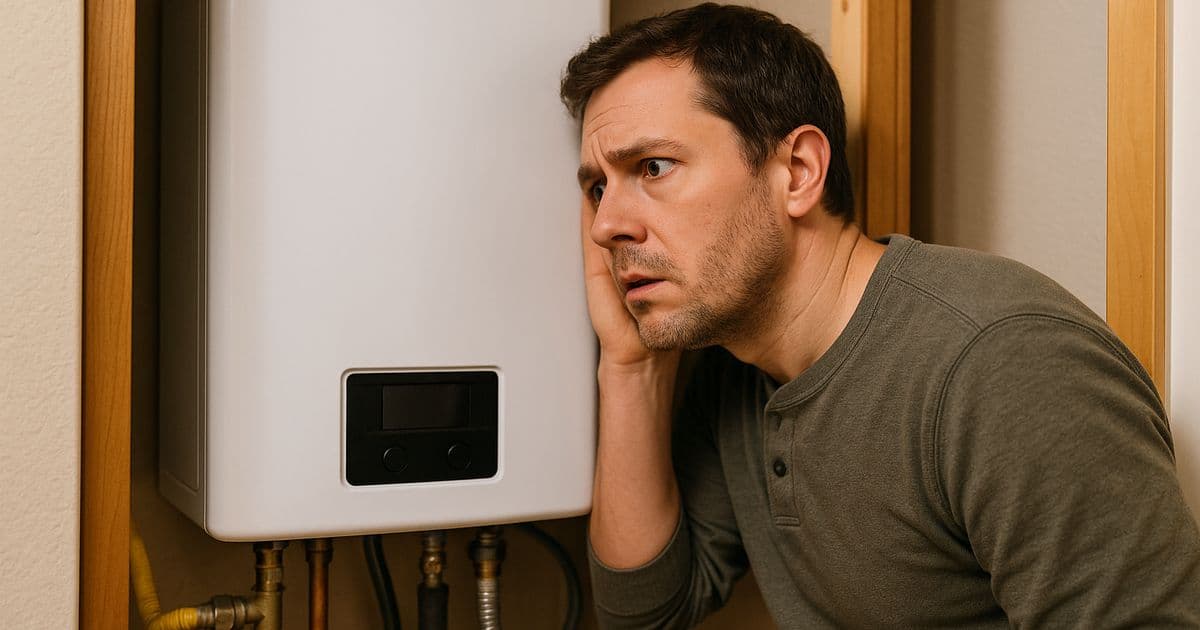
- You hear whistling, humming, or popping from the tankless unit
- You've noticed error codes on the display panel, especially overheating or ignition failure codes
- Temperature fluctuates along with the pressure drops
Signs It's Something Else (Flush Might Not Fix It)
- Both hot and cold water pressure are low. This points to a supply-side issue — your pressure regulator, a partially closed main shutoff, or a municipal supply problem. Your tankless unit isn't involved.
- Pressure dropped suddenly, not gradually. Scale buildup is slow. A sudden drop suggests a valve issue, a broken pressure regulator, or a pipe blockage.
- Only one fixture is affected. The problem is at that fixture — a clogged aerator, a failing cartridge, or a kinked supply line.
- The unit is brand new. If pressure has been low since installation, suspect undersized supply lines or incorrect installation. Our Rinnai vs. Navien vs. Noritz comparison covers flow rate specs across popular models to help verify your unit is properly sized.
If multiple fixtures show the same hot-side pressure loss and it's been getting worse over time, scale is your answer.
What Happens If You Ignore the Pressure Drop
Low hot water pressure is annoying, but ignoring it leads to consequences beyond weak showers:
Accelerating damage. The scale causing the restriction is also insulating the heat exchanger from the burner. The unit compensates by running longer and harder, increasing thermal stress on the exchanger. Over time, this stress can cause cracking or perforation — a repair that costs $800-$1,500.
Higher energy bills. A scaled heat exchanger transfers heat less efficiently. Your unit burns more gas to achieve the same water temperature — a problem we detail in why your tankless water heater is driving up your gas bill. In Orange County, where gas prices consistently exceed the national average, this inefficiency compounds quickly. The Department of Energy notes that tankless units can lose much of their efficiency advantage when scale restricts flow. Read more about how hard water affects your unit and what it costs over time.
Complete unit shutdown. If scale restricts flow enough, the unit's safety sensors will trigger error codes and shut down operation entirely. At that point, you have no hot water at all until the unit is serviced. Neglect over years also significantly shortens the overall lifespan of your tankless water heater.
Warranty complications. Most tankless water heater manufacturers require proof of regular maintenance to honor warranty claims. If your heat exchanger fails and you can't document that the unit was flushed on schedule, the manufacturer may deny the claim. That $1,500 repair is now entirely out of pocket. Our post on tankless water heater warranty requirements covers what manufacturers expect.
Prevention: Keep the Pressure Where It Should Be
The most reliable way to prevent hot water pressure loss in Orange County is a consistent flush schedule:
- Without a water softener: Every 6-9 months
- With a water softener: Every 12 months
- In South OC (350+ ppm water): Every 6 months is safest
Between flushes, periodically compare hot and cold water flow at your fixtures. If you notice the gap widening, don't wait for your next scheduled flush — move it up. Early intervention means lighter scale, easier removal, and full pressure restoration in a single service visit.
If you're also considering a water softener to reduce scale between flushes, read our guide on water softeners and tankless water heaters for Orange County-specific recommendations.
Get Your Pressure Back
If your hot water pressure has been declining, a $399 flush from Tankless Flush Pro will almost certainly fix it. We service every city in Orange County with flat-rate pricing — no trip fees, no hidden charges. The service includes commercial-grade descaling, inlet filter cleaning, full system inspection, and documentation that keeps your warranty intact.
Schedule your flush today and stop living with weak hot water pressure. The fix takes about an hour, and you'll feel the difference the moment we're done.