Do I Need a Water Softener If I Already Flush My Tankless Water Heater Every Year?
This is one of the most common questions we hear from Orange County homeowners, and the answer isn't as simple as picking one or the other. Flushing and water softening solve different parts of the same problem. Understanding what each one does — and what it can't do — is the key to protecting your tankless water heater for the long term without spending more than you need to.
How Hard Is Orange County Water?
Before we get into the flushing versus softener question, it helps to know exactly what you're dealing with.
Orange County's municipal water supply consistently tests between 250 and 400 parts per million (ppm) of dissolved calcium carbonate, as documented by the USGS water hardness data. Converted to grains per gallon — the measurement most water softener companies use — that's roughly 15 to 23 grains per gallon (gpg).
For context:
| Water Hardness | PPM | Grains per Gallon |
|---|---|---|
| Soft | 0-60 | 0-3.5 |
| Moderately Hard | 61-120 | 3.5-7.0 |
| Hard | 121-180 | 7.0-10.5 |
| Very Hard | 180+ | 10.5+ |
Orange County isn't just in the "very hard" category — it's in the upper half of it. South Orange County cities like Laguna Niguel, Lake Forest, and San Juan Capistrano routinely exceed 350 ppm. Even the relatively softer northern cities like Anaheim and Fullerton sit comfortably above 250 ppm.
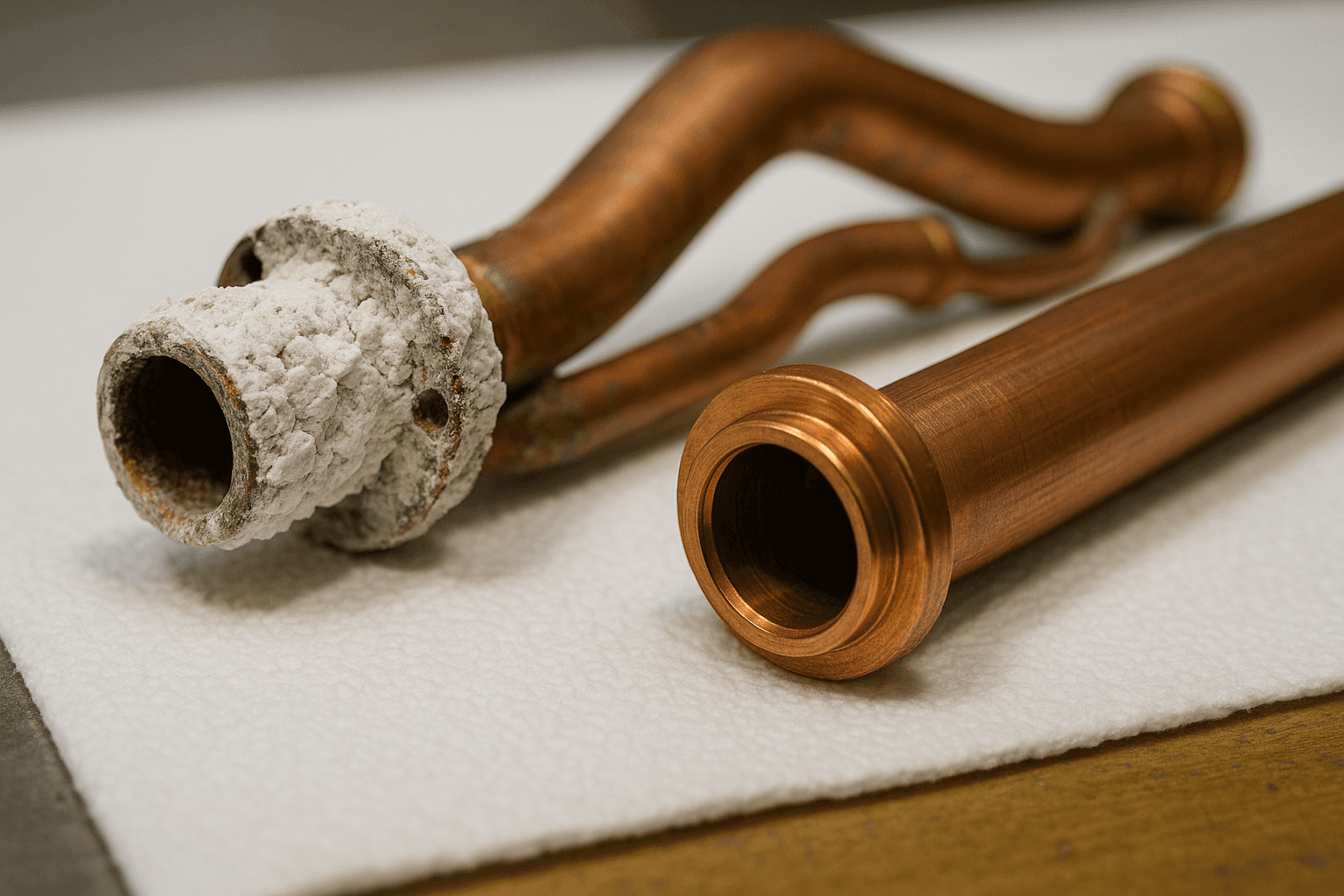
Every gallon of this hard water that passes through your tankless water heater leaves a small deposit of calcium and magnesium behind. Over months, those deposits become the rock-hard scale layer that chokes your heat exchanger.
What Scale Actually Does Inside Your Heat Exchanger Over Time
Your tankless water heater's heat exchanger is a series of narrow copper or stainless steel tubes surrounded by gas burner flames. Water flows through these tubes and absorbs heat as it passes. The design relies on direct metal-to-water contact for efficient heat transfer.
Scale disrupts this in three ways:
Insulation
Calcium scale is a poor conductor of heat. As it coats the interior walls of the heat exchanger tubes, it creates an insulating barrier between the burner flames and the water. The burner has to work harder and burn hotter to push the same amount of heat through the scale layer. This wastes gas and stresses the metal.
Flow Restriction
The tubes inside a heat exchanger are narrow by design — typically 6-10mm in diameter. A 1-2mm layer of scale on all sides reduces the cross-sectional area by 30-50%. Less water flows through per second, which means lower flow rates at the tap and more heat absorbed per unit of water that does pass through. This is what causes temperature spikes and overheating error codes.
Accelerating Buildup
Scale buildup is not linear. A smooth metal surface sheds some minerals with the flow of water. A rough, scaled surface traps more minerals with each pass. The rougher the surface gets, the faster new deposits accumulate. A unit that took nine months to build its first millimeter of scale may build the second millimeter in just four months.
This accelerating pattern is why neglected units in Orange County often go from "working fine" to "throwing error codes" in what feels like a short period. Recognizing the early warning signs that your tankless needs flushing can help you act before scale causes real damage. The scale was building slowly at first and then rapidly as it crossed the threshold.
Annual Flushing: What It Fixes, What It Cannot Undo
Professional flushing pushes a commercial-grade descaling solution through the heat exchanger, dissolving calcium and magnesium deposits and flushing them out of the system. It's the single most effective maintenance procedure for a tankless water heater.
What Flushing Accomplishes
- Removes accumulated scale from the heat exchanger walls, restoring the direct metal-to-water contact needed for efficient heat transfer
- Restores flow rate by clearing mineral deposits from the narrow tube passages
- Cleans sensors and components including flame rods, flow sensors, and temperature probes
- Resets efficiency to near-original levels
- Extends component lifespan by removing the insulating layer that causes overheating
What Flushing Cannot Do
- It cannot undo permanent damage. If scale caused the heat exchanger to overheat and crack, flushing won't repair the metal. If thermal stress from repeated overheating has weakened solder joints, flushing won't restore them.
- It cannot prevent new scale from forming. The moment fresh hard water enters the flushed heat exchanger, new deposits begin accumulating immediately. Flushing is a reset, not a shield.
- It cannot protect other appliances. Your dishwasher, washing machine, faucets, showerheads, and pipes are all subject to the same hard water. Flushing your tankless unit does nothing for the rest of your plumbing system.
This last point is important. Flushing is a targeted solution for one appliance. It's highly effective at what it does, but it only protects the tankless water heater.
What a Water Softener Does That Flushing Cannot
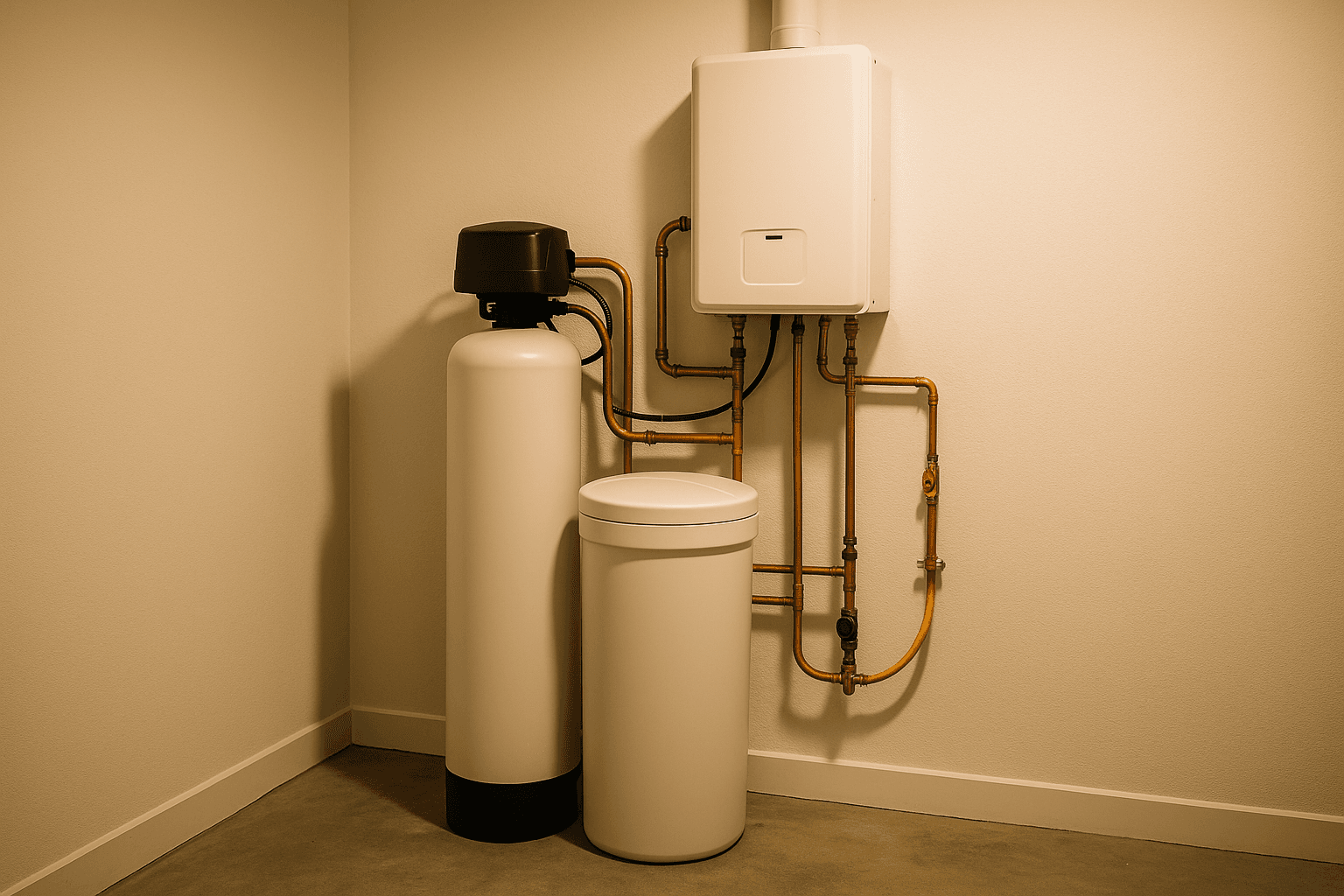
A whole-home water softener sits at the point where your main water supply enters your house. It uses an ion exchange process — as explained by the Water Quality Association — where water passes through a resin bed that swaps calcium and magnesium ions for sodium ions. The result is water that's nearly free of the minerals that cause scale.
What a Softener Accomplishes That Flushing Cannot
- Prevents scale formation proactively rather than removing it after the fact
- Protects your entire plumbing system — every fixture, appliance, and pipe in the house
- Reduces soap and detergent usage by 50% or more
- Eliminates hard water spots on glass, fixtures, and shower doors
- Extends the life of all water-using appliances — dishwashers, washing machines, and coffee makers last longer with softened water
- Dramatically slows scale accumulation in the tankless water heater, extending the safe interval between flushes
What a Softener Cannot Do
- It cannot remove existing scale. If your heat exchanger already has buildup, installing a softener won't dissolve what's already there. You need a flush to remove existing deposits, then the softener prevents new ones.
- It cannot provide 100% protection 100% of the time. Softeners regenerate every few days by backflushing the resin bed with salt brine. During regeneration, which typically takes 60-90 minutes, the system either bypasses hard water directly to your plumbing or stops water flow entirely (depending on the model). Hard water exposure during bypass is brief, but it's not zero.
- It cannot replace flushing entirely. Between regeneration bypasses, occasional salt shortages, and the possibility of softener malfunction, some mineral exposure will occur over time.
The Real Answer: Do You Need Both?
Yes — but the softener changes the equation significantly.
Think of it this way: flushing is treatment, and a softener is prevention. Treatment is essential when you don't have prevention. But even with prevention in place, periodic treatment is still wise because no preventive measure is 100% effective.
The practical benefits of running both:
- Your flush interval extends dramatically. Instead of every 6-9 months, you can safely flush every 18-24 months.
- Each flush is faster and easier. With minimal scale, the descaling solution works quickly and completely. There's no stubborn, hardened buildup to fight.
- Your heat exchanger stays in near-new condition. Minimal scale means minimal efficiency loss, minimal overheating stress, and maximum lifespan.
- Your entire house is protected. Showerheads stop clogging, faucet aerators stay clean, glass shower doors stay clear, and all appliances benefit.
If you already have a softener and you're wondering whether you still need to flush — yes, you do, just less often. If you don't have a softener and you're wondering whether flushing alone is enough — yes, it is, but you'll need to flush more frequently.
How Often to Flush: With Softener vs. Without
The right flush interval depends on your water hardness and whether you have a softener. Here's the schedule we recommend for Orange County:
Without a Water Softener
| Water Hardness | Recommended Flush Interval |
|---|---|
| 250-300 ppm | Every 9-12 months |
| 300-350 ppm | Every 6-9 months |
| 350-400+ ppm | Every 6 months |
Most of Orange County falls in the 6-9 month range without a softener.
With a Properly Maintained Water Softener
| Water Hardness (Pre-Softener) | Recommended Flush Interval |
|---|---|
| 250-300 ppm | Every 24 months |
| 300-350 ppm | Every 18-24 months |
| 350-400+ ppm | Every 18 months |
"Properly maintained" is the key qualifier. A softener that runs out of salt or has a faulty bypass valve isn't protecting your unit. Check your salt level monthly and have your softener tested annually to confirm it's reducing hardness to below 5 gpg.
Cost Comparison: Softener Investment vs. Repair/Replacement Over 10 Years
Let's run the numbers for the three most common scenarios over a 10-year period.
Scenario 1: Flushing Only (No Softener)
- Flush frequency: Every 8 months (average for Orange County)
- Flushes over 10 years: 15
- Cost per flush: $399
- Total flushing cost: $3,735
- Expected unit lifespan: 15-20 years (maintained)
- Repair risk: Low with consistent maintenance
- Total 10-year cost: ~$3,735
Scenario 2: Water Softener Only (No Flushing)
- Softener installation: $2,500 (average)
- Monthly salt and maintenance: $10/month = $1,200 over 10 years
- Flush frequency: None
- Risk: Bypass events and softener failures allow periodic scale accumulation
- Likely repair in years 5-8: $300-$800 for scale-related component issues
- Total 10-year cost: ~$4,000-$4,500
Scenario 3: Both Softener and Flushing
- Softener installation: $2,500
- Monthly salt and maintenance: $10/month = $1,200 over 10 years
- Flush frequency: Every 21 months (average with softener)
- Flushes over 10 years: 5-6
- Cost per flush: $399
- Total flushing cost: $1,245-$1,494
- Repair risk: Very low
- Total 10-year cost: ~$4,945-$5,194
Which Scenario Wins?
On pure cost, Scenario 1 (flushing only) is the least expensive over 10 years — but only if you're disciplined about maintaining the schedule. Miss a couple of flushes and you risk a $800-$1,500 heat exchanger repair that erases the savings.
Scenario 3 (both) is the most protective and has the lowest risk of unexpected repairs, but it's the most expensive upfront and over time.
Scenario 2 (softener only) is the riskiest because it relies on a single point of failure with no backup maintenance. If the softener fails or bypasses hard water, you have no safety net.
Our Recommendation
For most Orange County homeowners, the right approach depends on your situation:
- If you already have a water softener: Add regular flushing every 18-24 months. You're spending very little for significant protection. Schedule your flush.
- If you don't have a softener and don't plan to install one: Flush every 6-9 months. This is the cost-effective approach that keeps your unit protected. Set up your schedule.
- If you're building, remodeling, or replacing plumbing: Install a water softener and plan for flushes every 18-24 months. The upfront investment pays off in protection for your entire plumbing system, not just the tankless unit.
The Bottom Line
Flushing and softening are complementary, not interchangeable. Flushing removes scale that has already formed. Softening prevents scale from forming in the first place. In Orange County's exceptionally hard water, the most reliable protection for your tankless water heater involves some form of both — either frequent flushing alone or a softener paired with less frequent flushing.
Tankless Flush Pro provides flat-rate $399 tankless water heater flushing throughout Orange County. Every service includes commercial-grade descaling, filter cleaning, full system inspection, and warranty-compliant documentation. Whether you have a softener or not, we'll assess your unit's condition and recommend the right maintenance interval for your specific water hardness.
Schedule your flush today and keep your tankless water heater running at peak efficiency.