Tankless Water Heater Keeps Shutting Off? Here's Why and How to Fix It Fast
You're mid-shower when the water goes cold. You hear the unit click off. You wait, it restarts, the hot water comes back for two minutes, and then it shuts off again. Or maybe it won't restart at all, and you're staring at an error code you've never seen before.
A tankless water heater that keeps shutting off is one of the most frustrating problems a homeowner can face, because the unit was supposed to be the reliable, always-on alternative to a tank. When it starts cycling on and off — or locking out entirely — something specific is wrong, and the fix depends on identifying the right cause.
Here are the five most common reasons your tankless water heater keeps shutting off, ranked by how frequently we see each one in Orange County service calls.
Cause 1: Scale Buildup Is Triggering Safety Shutoffs
This is the cause in roughly 60-70% of the shutdown calls we respond to in Orange County. It's also the most preventable.
What's Happening Inside the Unit
Your tankless water heater has multiple safety sensors designed to protect the heat exchanger from damage. Two of the most critical are the overheat sensor and the flow sensor. Both are directly affected by scale buildup.
When mineral scale coats the heat exchanger, two things happen simultaneously. First, the insulating layer prevents heat from transferring efficiently to the water, causing the metal of the heat exchanger itself to run hotter than it should. The overheat sensor detects this elevated temperature and shuts the unit down to prevent thermal damage.
Second, scale narrows the internal passages of the heat exchanger, restricting water flow. When flow drops below the unit's minimum activation threshold — typically 0.4-0.6 gallons per minute — the flow sensor tells the control board there isn't enough water moving through the system to safely operate the burner. The unit shuts down.
In both scenarios, the shutoffs are the unit doing exactly what it's supposed to do. The safety systems are working. The problem is the scale that's triggering them.
How to Identify Scale as the Cause
Scale-related shutdowns have a distinctive pattern:
- The unit runs for a short period (30 seconds to a few minutes) before shutting off
- The shutdowns have gotten progressively more frequent over weeks or months
- You may see error codes related to overheating (Rinnai 14, Navien E016, Noritz 16) or ignition failure (Rinnai 11, Navien E003, Noritz 11)
- Hot water pressure is noticeably weaker than cold water pressure
- The unit hasn't been flushed in 12+ months
If this matches your situation, a professional descaling flush is the first step. It resolves the problem approximately 70-80% of the time. Read more about scale-related error codes and what they mean.
Cause 2: Clogged Flow Sensor or Inlet Filter
Every tankless water heater has an inlet filter — a small mesh screen where the cold water supply enters the unit. This filter catches sediment, debris, and mineral particles before they reach the heat exchanger. Over time, the filter clogs, and water flow drops.
The Flow Sensor Connection
The flow sensor measures how much water is moving through the unit. When the inlet filter is clogged, flow drops below the minimum activation threshold. The unit won't fire — or it fires briefly and then shuts off because the sensor detects inadequate flow.
This is particularly common in older homes with galvanized pipes that shed sediment, homes after construction or remodeling where pipe debris hasn't been fully flushed, and areas with high sediment in the municipal water supply.
How to Check and Fix
The inlet filter is usually accessible without tools on most Rinnai, Navien, and Noritz models. Check the manufacturer's support pages (Rinnai support, Navien support) for model-specific filter location diagrams. Turn off the cold water supply valve, remove the filter (it typically unscrews or pulls out), clean it under running water, and reinstall it. If the filter is heavily clogged, this alone may restore proper flow and stop the shutdowns.
If the shutdowns continue after cleaning the filter, the flow sensor itself may be coated with mineral deposits or malfunctioning. A professional technician can clean or replace the flow sensor during a standard service visit.
Cause 3: Venting Blockages
Gas tankless water heaters require proper venting to exhaust combustion gases. If the vent pipe is blocked, partially obstructed, or improperly installed, the unit will detect abnormal exhaust conditions and shut down.
Common Venting Problems
- Bird nests or debris in the exhaust termination point on your exterior wall or roof
- Condensation buildup in horizontal vent runs without proper slope
- Incorrect vent pipe diameter — undersized pipe creates backpressure
- Vent pipe disconnection at joints, allowing exhaust to leak into the utility space
Error Codes to Watch For
Venting-related shutdowns typically trigger specific codes:
- Rinnai Code 10 — Blocked exhaust
- Navien E012 — Flame loss (can indicate venting issues)
- Noritz Error 90 — Combustion abnormality from venting problems
How to Check
Walk outside and locate where your tankless unit's vent exits the house. Look for visible obstructions — nests, leaves, or clogged insect screens. If the termination point is clear, the blockage may be inside the vent pipe, which requires a technician to diagnose.
Venting repairs are not DIY territory. Improper venting creates carbon monoxide risks, and any vent system work should be handled by a licensed professional.
Cause 4: Dirty or Failing Flame Rod
The flame rod (also called a flame sensor or flame rectifier) is a small metal probe that extends into the burner flame. Its job is straightforward: confirm to the control board that the burner has successfully ignited and that a stable flame is present.
Why Flame Rods Cause Shutdowns
When the flame rod is coated with mineral deposits, carbon residue, or oxidation, it can't accurately detect the flame. The control board interprets the weak signal as a failed ignition — even though the flame is burning normally — and shuts the unit down as a safety precaution.
The shutdown pattern with a dirty flame rod is distinctive:
- The unit ignites normally (you hear the burner fire)
- It runs for 3-10 seconds
- It shuts off abruptly
- It may attempt to reignite several times before locking out with an ignition failure code
This is different from scale-related shutdowns, which typically allow the unit to run for longer periods before triggering an overheat condition.
The Fix
Flame rod cleaning is a standard part of a professional tankless water heater service. The technician removes the rod, cleans it with fine abrasive (typically emery cloth or fine-grit sandpaper), and reinstalls it. The entire process takes about five minutes and immediately restores reliable flame detection.
If the flame rod is corroded, pitted, or cracked, it needs to be replaced. Replacement rods cost $15-$40 for the part, and most technicians carry them on their truck.
Cause 5: Gas Supply Issues
If your tankless water heater isn't getting enough gas, it can't maintain a stable flame. The unit will either fail to ignite or shut down shortly after ignition.
Common Gas Supply Problems
- Undersized gas line — particularly in homes where a tankless unit replaced a smaller tank water heater without upgrading the gas supply line
- Low gas pressure — can be caused by multiple gas appliances running simultaneously (furnace, dryer, cooktop, and water heater all demanding gas at once)
- Partially closed gas valve — check that the gas shut-off valve to the unit is fully open
- Gas meter capacity — in rare cases, the gas meter itself may be undersized for the total BTU demand of the home
How to Identify Gas Supply Issues
Gas supply problems typically cause shutdowns that coincide with other gas appliances running. If your tankless water heater shuts off every time the furnace kicks on or when you're using the gas cooktop, simultaneous demand is exceeding supply.
This is not a DIY diagnosis. A licensed plumber or gas technician needs to measure gas pressure at the unit while other appliances are operating to confirm whether supply is adequate.
When to Reset vs. When to Call a Professional
Not every shutdown requires a service call. Here's a framework for deciding your next step.
Reset First (Safe to Try)
- The unit shut down once after a power blip or brief interruption
- You see an error code you've never seen before, and the unit has been working fine
- The shutdown happened during an unusual situation (multiple fixtures running, very low flow from a single faucet)
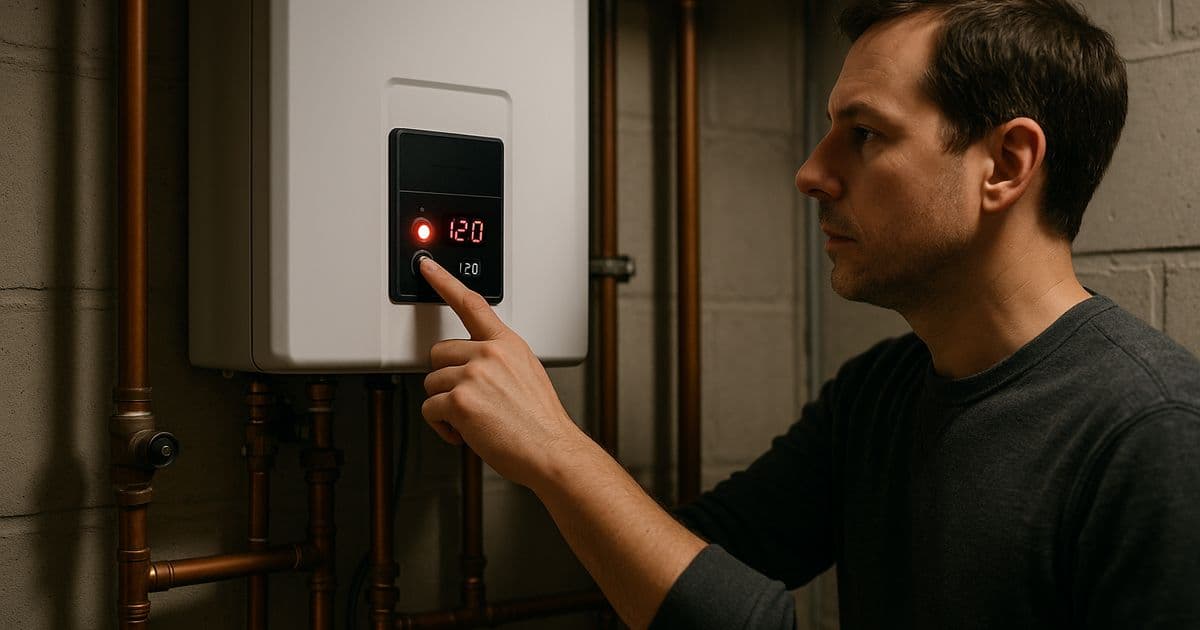
How to reset: Turn the unit off using the power button or circuit breaker. Wait 30 seconds. Turn it back on. If the unit starts normally and operates without shutting down again, the issue may have been transient.
Call a Professional (Don't Keep Resetting)
- The unit shuts down again within minutes or hours of resetting
- The same error code keeps returning
- You notice the shutdowns have been getting more frequent over time
- There's any smell of gas near the unit
- The unit makes unusual sounds before shutting down
- It's been more than 12 months since the last flush
Repeated resets on a unit with a persistent problem don't solve anything. They mask the symptom while the underlying cause — usually scale — continues to worsen, driving up your gas bill in the process. Each shutdown-restart cycle also stresses ignition components, creating secondary problems on top of the original one.
The Orange County Factor
Hard water is the accelerant behind most of these shutdown causes. Scale builds on heat exchangers, coats flame rods, clogs inlet filters, and narrows flow passages — often causing low hot water pressure and unusual popping or banging sounds before triggering full shutdowns. In Orange County's 250-400 ppm water, these problems develop 2-3 times faster than in areas with average water quality.
A tankless water heater in a soft water area might go 2-3 years before scale-related shutdowns appear. In Irvine, Anaheim, Huntington Beach, or any other Orange County city, that timeline compresses to 9-15 months without regular maintenance.
The single most effective thing you can do to prevent shutdowns is flush your unit on schedule — every 6-9 months without a water softener, every 12 months with one.
Stop the Cycle of Shutdowns
If your tankless water heater keeps shutting off, there's a specific, diagnosable reason. In the majority of cases, that reason is mineral scale — and a professional descaling flush resolves it in a single visit.
Tankless Flush Pro provides flat-rate $399 flushing across all of Orange County. Every service includes commercial-grade descaling, inlet filter cleaning, flame rod inspection, full system diagnostics, and warranty-compliant documentation. No trip fees. No surprise charges.
Visit our FAQ page for quick answers, or schedule your service today and get your tankless water heater running reliably again.