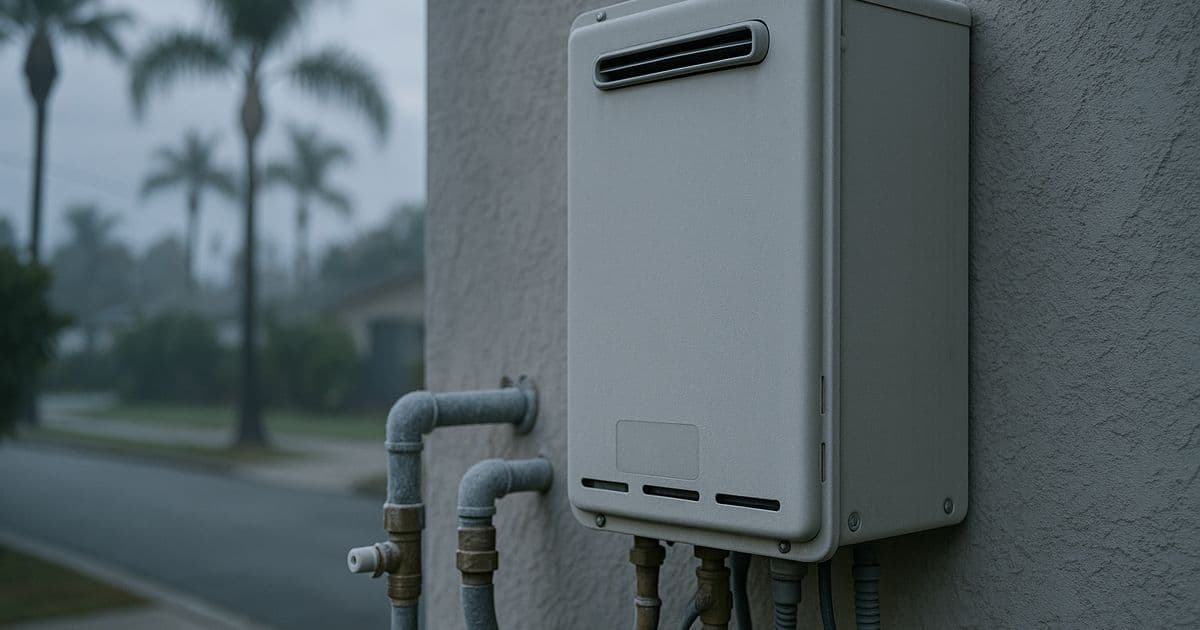
Why Your Tankless Struggles Every Winter (What Orange County Homeowners Should Know)
Every December, our call volume spikes. The complaints are consistent: not enough hot water, temperature fluctuations, the unit shutting off mid-shower, error codes that never appeared in summer. Homeowners who had zero issues with their tankless water heater from April through October suddenly can't get through a morning shower without problems.
This isn't a coincidence, and your unit probably isn't failing. Winter exposes problems that have been building silently for months — problems that stay hidden when conditions are easier and reveal themselves only when your unit is pushed to its limits.
Here's why winter is the hardest season for your tankless water heater, and what Orange County homeowners should do before the temperature drops.
The Cold Inlet Water Problem: Physics Working Against You
Most homeowners don't realize that their tankless water heater doesn't heat water to a set temperature. It heats water by a temperature rise — the difference between the inlet water temperature and the set output temperature. This distinction matters enormously in winter.
Summer vs. Winter in Orange County
In summer, groundwater entering your home through the municipal supply runs between 65 and 70 degrees Fahrenheit. If your thermostat is set to 120 degrees, the unit needs to raise the water temperature by 50-55 degrees. Most residential tankless units handle this comfortably, even with multiple fixtures running.
In winter, that same groundwater drops to 50-55 degrees. Now the unit needs a 65-70 degree temperature rise — roughly 30% more heating work per gallon of water.
What This Means for Your Unit's Capacity
Every tankless water heater has a maximum flow rate at a given temperature rise. A unit rated for 8 gallons per minute at a 35-degree rise might deliver only 5 GPM at a 55-degree rise. At a 70-degree rise — the winter demand in Orange County — that same unit might max out at 3.5-4 GPM.
That 3.5-4 GPM is enough for one shower (2-2.5 GPM) and a kitchen faucet (1-1.5 GPM) running simultaneously. But add a dishwasher, a second shower, or a washing machine, and you've exceeded the unit's winter capacity. The water either comes out cooler than you set it, or the unit shuts down from overload.
This capacity reduction happens to every tankless water heater in winter, regardless of brand, age, or maintenance status. It's physics. But here's where maintenance becomes critical: if scale has already reduced your unit's effective capacity by 20-25%, winter's additional demands push a compromised unit past its breaking point.
A unit that lost 25% of its capacity to scale might still deliver acceptable performance in summer — you'd never notice the difference. In winter, that same 25% loss means the unit can't keep up with even basic household demand.
Why Winter Exposes Neglected Scale
This is the core issue behind most winter tankless complaints we see in Orange County. The unit wasn't struggling because winter broke something. It was struggling because scale had been slowly degrading performance for months, and winter finally made the degradation impossible to ignore.
Think of it like running with a weighted vest. During an easy jog (summer — low temperature rise, low demand), you might not notice the extra weight. During a sprint uphill (winter — high temperature rise, high demand), that same weight makes the difference between finishing and stopping.
Every month of unflushed operation adds more weight. Scale from Orange County's 250-400 ppm hard water accumulates steadily on the heat exchanger, reducing heat transfer efficiency by a fraction of a percent each week. By the time the first cold morning hits in late November, a unit that hasn't been flushed since last spring has lost enough capacity that winter demand exceeds what it can deliver.
The warning signs that your unit needs flushing — temperature fluctuations, reduced pressure, error codes — all become more pronounced and more frequent in winter because the unit is operating at its margins. The same scale that caused a minor temperature wobble in July causes a full shutdown in January.
Freeze Protection: Built-In vs. What You Need to Add
Orange County isn't Minnesota, but freeze risk isn't zero. Inland areas like Yorba Linda, Rancho Santa Margarita, Brea, and north Orange County can see overnight lows near or below freezing several times per winter. Coastal areas are warmer, but even Irvine and Mission Viejo occasionally dip into the mid-30s.
Built-In Freeze Protection
Most modern tankless water heaters from Rinnai, Navien, and Noritz include built-in electric freeze prevention. The U.S. Department of Energy recommends verifying that your unit's freeze protection system is functioning before winter arrives. When the unit's internal temperature sensor detects temperatures approaching freezing, it activates a small electric heater that keeps the heat exchanger and internal components above 32 degrees.
This protection has two important limitations:
It requires electrical power. If the power goes out during a cold snap — which happens — the freeze protection doesn't work. The unit's internal water can freeze, expand, and crack the heat exchanger. This is rare in Orange County but not unheard of during Santa Ana wind events that knock out power during cold winter nights.
It only protects the unit itself. The water supply and hot water lines running to and from the unit are not covered by the built-in system. These exposed pipes, particularly on outdoor-mounted units, are vulnerable to freezing even when the unit itself is protected.
Outdoor Unit Insulation
If your tankless water heater is mounted outdoors — which is common in Orange County where garage and exterior installations are the norm — the exposed water lines need separate freeze protection. Consult your manufacturer's winterization guidelines (Rinnai, Navien) for model-specific instructions.
Pipe insulation foam (the pre-slit tube type from any hardware store) on all exposed hot and cold water lines is the minimum. For homes in inland areas, adding thermostat-controlled heat tape to the lines provides active protection that kicks in when temperatures drop.
The unit itself is designed for outdoor installation and doesn't need additional insulation — the internal freeze protection handles that. Focus your winterizing efforts on the pipes.
Power Outage Precautions
If a freeze warning coincides with a power outage, the safest step is to shut off the water supply to the unit and open a hot water tap inside the house to drain the water from the heat exchanger. This prevents standing water from freezing inside the unit. Once power returns and temperatures rise, close the tap, reopen the supply valve, and resume normal operation.
Pre-Winter Flush Timing: Why September-October Is Ideal
The best time to flush your tankless water heater is before it enters its hardest working season. In Orange County, that means scheduling a flush in September or October — after the summer's moderate demand period and before the cold inlet temperatures of November through February.
Why Timing Matters
A pre-winter flush accomplishes three things simultaneously:
Restores full heating capacity. By removing summer's accumulated scale, the unit enters winter with clean heat exchanger surfaces and maximum heat transfer efficiency. The 25% capacity loss from scale that would have made winter miserable is eliminated. A clean unit also lasts significantly longer, since winter stress on a scaled heat exchanger accelerates long-term wear.
Prevents winter error codes and shutdowns. Scale-related error codes — Rinnai LC, Navien E016, Noritz Error 16 — are most likely to appear in winter when the unit is under maximum stress. A pre-winter flush removes the trigger before the symptoms appear.
Reduces winter gas bills. A clean heat exchanger transfers heat efficiently, which means lower gas consumption per heating cycle. During winter — when the unit works hardest and longest — the efficiency savings from a clean unit versus a scaled one are at their highest.
What If You Missed the Pre-Winter Window?
If it's already December, January, or February and your unit is struggling, don't wait until spring. A mid-winter flush is still effective and will immediately improve performance for the remainder of the cold season. The scale doesn't care what month it gets removed — your unit will run better as soon as it's clean.
Winter-Specific Troubleshooting for Orange County Homeowners
If your tankless water heater is underperforming this winter, run through this checklist before calling for service.
Lower Your Temperature Setting Temporarily
If you normally set your unit to 120 degrees, try dropping it to 115. That 5-degree reduction decreases the temperature rise the unit needs to achieve, which can bring a struggling unit back within its operational capacity. It's a stopgap, not a fix — but it can get you through until your flush appointment.
Reduce Simultaneous Hot Water Demand
Stagger your hot water usage during winter. Run the dishwasher after showers, not during. Avoid running the washing machine on hot while someone is showering. In winter, your unit's effective capacity is at its lowest, and asking it to serve multiple fixtures simultaneously may exceed what it can deliver.
Check the Inlet Filter
A partially clogged inlet filter compounds winter capacity problems. If the filter restricts flow, the unit has even less water flowing through the heat exchanger, further reducing output. The filter is usually accessible without tools — check your owner's manual for the location and removal procedure.
Listen for Unusual Sounds
Popping, rumbling, or gurgling sounds during operation in winter are strong indicators of scale on the heat exchanger. These sounds occur when water contacts superheated scale deposits and briefly flashes to steam. If you're hearing these alongside winter performance issues, scale is almost certainly the cause.
The Winter Performance Gap Is Preventable
Every winter performance complaint we handle in Orange County follows the same pattern: a unit that hasn't been flushed in 12+ months gets pushed to its limits by cold inlet water and can't keep up. The homeowner thinks the unit is failing. In reality, it just needs to be cleaned.
The fix is a $399 professional flush — commercial-grade descaling that restores the heat exchanger to near-factory efficiency, plus inlet filter cleaning, system inspection, and warranty-compliant documentation. One service visit, and your unit enters winter ready to handle whatever Orange County's cold season delivers.
Tankless Flush Pro services all of Orange County with flat-rate pricing and no trip fees. Whether you're in coastal Newport Beach or inland Yorba Linda, the price is the same and the service is the same.
Schedule your pre-winter flush today — or if winter's already here and your unit is struggling, book a mid-season service to get your hot water back on track immediately.