Brown or Discolored Hot Water? What Your Tankless Water Heater Is Telling You
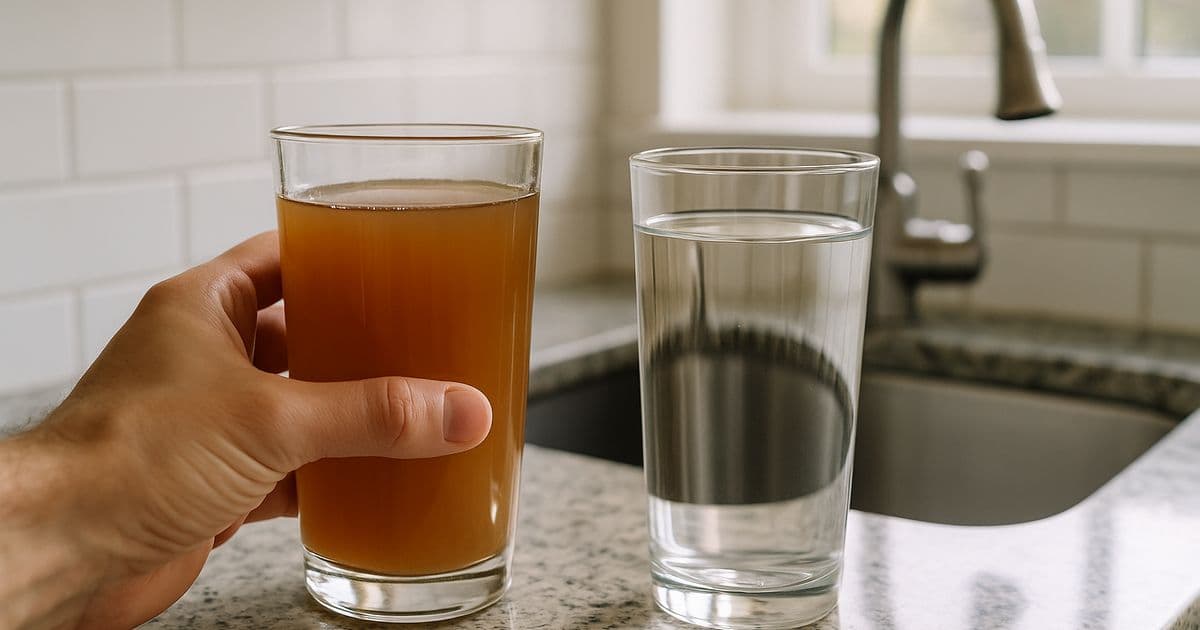
You turn on the kitchen faucet and what comes out is brown, yellow, or rust-colored. It might clear up after running for a few seconds — or it might not. Either way, it's alarming.
If the discoloration only appears when you run hot water and your cold water is clear, your tankless water heater is almost certainly the source. This is not a rare problem in Orange County, and it's not one you should ignore. The discolored water is a symptom of a deeper issue that will get worse without intervention.
What Causes Discolored Hot Water from a Tankless Unit
There are three primary causes. Understanding which one is affecting your home determines the right fix.
Cause 1: Scale and Mineral Sediment
This is the most common cause in Orange County by a significant margin. Every gallon of hot water your household uses passes through the tankless heat exchanger, and OC's water carries 250-400 parts per million of dissolved calcium and magnesium. Each time the unit fires, those minerals precipitate out and deposit onto the heat exchanger walls.
Over time, these deposits build up in layers. The inner layers become extremely hard and dense. The outer layers remain chalky and fragile. As water flows through the scaled exchanger, fragments break loose and enter your hot water supply. These fragments appear as brownish, tan, or off-white particles that give the water a cloudy or discolored tint.
The discoloration is typically worse first thing in the morning or after the unit has been idle. During idle periods, water sits in contact with scaled surfaces, absorbing more dissolved minerals. The first hot water draw flushes that mineral-saturated water to your taps.
Cause 2: Iron Oxide and Rust
If the discoloration is more red-brown or orange rather than tan or grey, iron is likely involved. Two sources are common:
Internal corrosion. Scale actually accelerates corrosion. When mineral deposits coat a metal surface, they create an oxygen-depleted zone between the scale and the metal, promoting under-deposit corrosion. When scale flakes off — or is disturbed by water flow — it takes corroded metal particles with it, producing rusty-colored water.
Upstream pipe corrosion. Homes with older galvanized steel pipes (common in Orange County homes built before the 1980s) shed iron oxide into the water. Heat inside the tankless unit can cause iron particles that were stable in cold water to dissolve or dislodge, intensifying the discoloration on the hot side.
Cause 3: Disturbed Municipal Sediment
Occasionally, brown water comes from the city supply rather than your plumbing. This happens during fire hydrant testing, water main repairs, or line flushing. The key indicator: both hot and cold water are discolored. If cold water is also brown, the source is upstream of your heater. This is usually temporary and resolves within hours.
Is Discolored Hot Water Safe?
Mineral sediment (scale): Not dangerous in typical concentrations. Calcium and magnesium are naturally occurring and the levels in residential systems are well below health concern thresholds. But you shouldn't consume visibly cloudy or gritty water regularly — it signals a maintenance problem.
Iron oxide (rust): Low levels aren't a health hazard. The EPA classifies iron as a secondary contaminant with an aesthetic guideline, not a health-based standard. However, persistently rusty water can indicate pipe deterioration that may eventually lead to leaks, and it stains fixtures, laundry, and dishes. The Water Quality Association is another good resource for understanding contaminant thresholds.
Bacterial contamination: In rare cases, brown water can indicate iron bacteria that feed on dissolved iron. These aren't harmful but produce slimy biofilm that clogs fixtures. If discolored water has an unusual smell — metallic, musty, or sewage-like — a water test is worth pursuing.
The practical answer: For most Orange County homeowners, the cause is mineral sediment from a scaled heat exchanger. Run the tap until it clears, don't drink or cook with visibly discolored water, and schedule a flush.
How a Professional Flush Clears It
A professional flush directly addresses the most common cause — scale and sediment inside the heat exchanger.
The technician isolates the unit from your home's plumbing, then circulates commercial-grade descaling solution through the heat exchanger for 45-60 minutes. This solution — significantly stronger than household vinegar — dissolves calcium, lime, and mineral deposits. As scale dissolves, the results are visible in the fluid itself: clean water goes in, brown or milky water comes out.
After descaling, clean water flushes all remaining solution and dissolved minerals from the system. The technician also removes and cleans the inlet filter — a mesh screen that catches sediment before it enters the exchanger. In heavily scaled units, this filter is often partially or fully clogged.
Results You'll See Immediately
- Clear water instead of cloudy or discolored
- Stronger flow rate from hot water taps
- Faster heat-up time — and lower energy costs, since a scaled unit drives up your gas bill
- No gritty particles
- Reduced or eliminated temperature fluctuations
If the discoloration was caused by scale — the most common scenario in Orange County — a single flush typically resolves the problem completely.
Pipe Corrosion vs. Scale: How to Tell the Difference
The fix depends on correctly identifying the source.
Signs Pointing to Scale
- Discoloration is tan, grey, or light brown
- Fine chalky or gritty particles in the water
- Unit hasn't been flushed in 12+ months
- Flow rate and temperature have gradually declined
- Worst on the first draw of the day
- Only hot water is affected
Signs Pointing to Pipe Corrosion
- Discoloration is red-brown, orange, or rust-colored
- House has galvanized steel pipes (pre-1980 OC homes)
- Discoloration persists even after flushing
- Multiple distant fixtures produce discolored water
- Rust stains on porcelain, white laundry, or dishes
Signs Pointing to Municipal Supply
- Both hot and cold water are discolored
- Appeared suddenly, not gradually
- Neighbors report the same issue
- Resolves on its own within hours
In some older Orange County homes — original galvanized piping plus a neglected tankless unit — the discoloration is both scale and corrosion. A flush clears the scale component, but if rusty water returns within weeks, the piping needs inspection or replacement. Persistent corrosion also shortens the overall lifespan of your unit — see how long tankless water heaters last for what to expect with proper care.
Prevention in Orange County
Given OC's water hardness, preventing brown water comes down to consistent maintenance.
Stick to an Aggressive Flush Schedule
In areas above 300 ppm — most of South and Central Orange County — flushing every 6-9 months is the minimum. If you've already had a brown water episode, consider every 6 months for the next year to ensure all accumulated sediment is cleared.
Don't rely on manufacturer-recommended 12-month intervals. Those guidelines assume national average water hardness, which is roughly half of what you're dealing with. Skipping flushes also puts your manufacturer warranty at risk. For more on why OC demands a different schedule, read our deep dive on hard water in Orange County and your tankless water heater.
Consider a Water Softener
A whole-home softener removes calcium and magnesium before water reaches the unit, dramatically slowing scale formation and extending flush intervals. A quality system costs $1,500-$3,500 installed. It doesn't eliminate the need for flushing — softeners can malfunction or bypass during regeneration — but it makes the problem more manageable. See our detailed comparison in water softeners and tankless water heaters in Orange County.
Clean the Inlet Filter Between Flushes
The inlet filter catches sediment before it enters the heat exchanger. In hard water areas, it can clog between service visits. Cleaning is straightforward: turn off the cold water supply, remove the filter (usually requires pliers), rinse under running water, and reinstall. Check your owner's manual for the exact location.
Monitor Your Water Quality
Get in the habit of glancing at hot water when you run the tap. Clear water is the baseline. Any persistent cloudiness or particles are early warnings that your next flush is overdue. Don't wait for visibly brown water — by that point, scale accumulation is already substantial.
When to Call a Plumber Instead
A flush resolves brown water caused by scale about 90% of the time. But some situations require a plumber:
- Persistent discoloration after flushing — the source is likely corroded pipes, not the unit
- Leaking from the unit — corrosion may have perforated the heat exchanger
- Both hot and cold water are brown — points to supply-side issues like corroded main lines
- Error codes for overheating or ignition failure that persist after flushing — may indicate mechanical problems. Check our error code guide for specifics
Clear Water Starts with a Clean Heat Exchanger
Brown water is your tankless unit telling you that maintenance is overdue. In Orange County's hard water, this isn't a matter of if — it's when. The only question is whether you address it proactively with scheduled flushing or reactively after the water turns brown and the exchanger is heavily scaled.
Tankless Flush Pro provides flat-rate $399 flushing throughout Orange County. Every service includes commercial-grade descaling, inlet filter cleaning, full system inspection, and warranty-compliant documentation. No trip fees. No hidden charges.
Have questions about flush frequency or what to expect? Visit our FAQ for answers. Schedule your flush today and get back to clear, clean hot water.